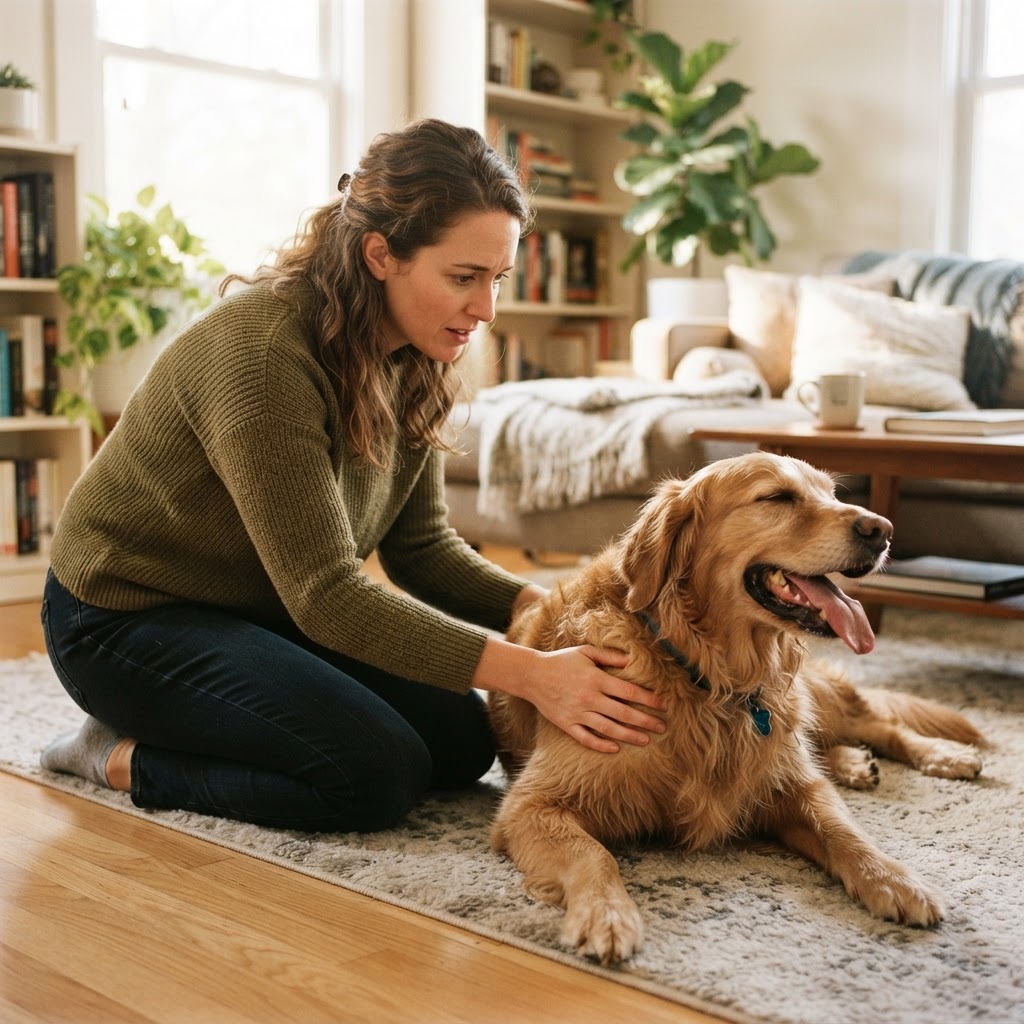
How to Tell If Your Dog Is in Pain: 12 Silent Signs Most Owners Miss, What to Do & When to Rush to the Vet
Dogs are hardwired by evolution to hide pain — which means by the time most owners notice, the discomfort has often been building for weeks. Learn the 12 silent signs veterinarians wish every dog parent knew, understand the difference between acute and chronic pain, and know exactly when to seek help.
Written by the Raise Happy Dog editorial team and researched from 11 veterinary and scientific sources listed at the end. Educational only — not a substitute for your veterinarian. Read our editorial policy.
She was not limping. She was not crying. She greeted you at the door with the same soft eyes and wagging tail she always does.
But something was different. Maybe she was a little slower getting up from her bed this morning. Maybe she flinched — just barely — when you scratched behind her ears. Maybe she has been sleeping more, or stopped jumping onto the sofa, or has been licking her left paw every evening for the past two weeks.
You noticed. And that quiet, nagging feeling in your gut — the one that whispers something is not quite right — brought you here.
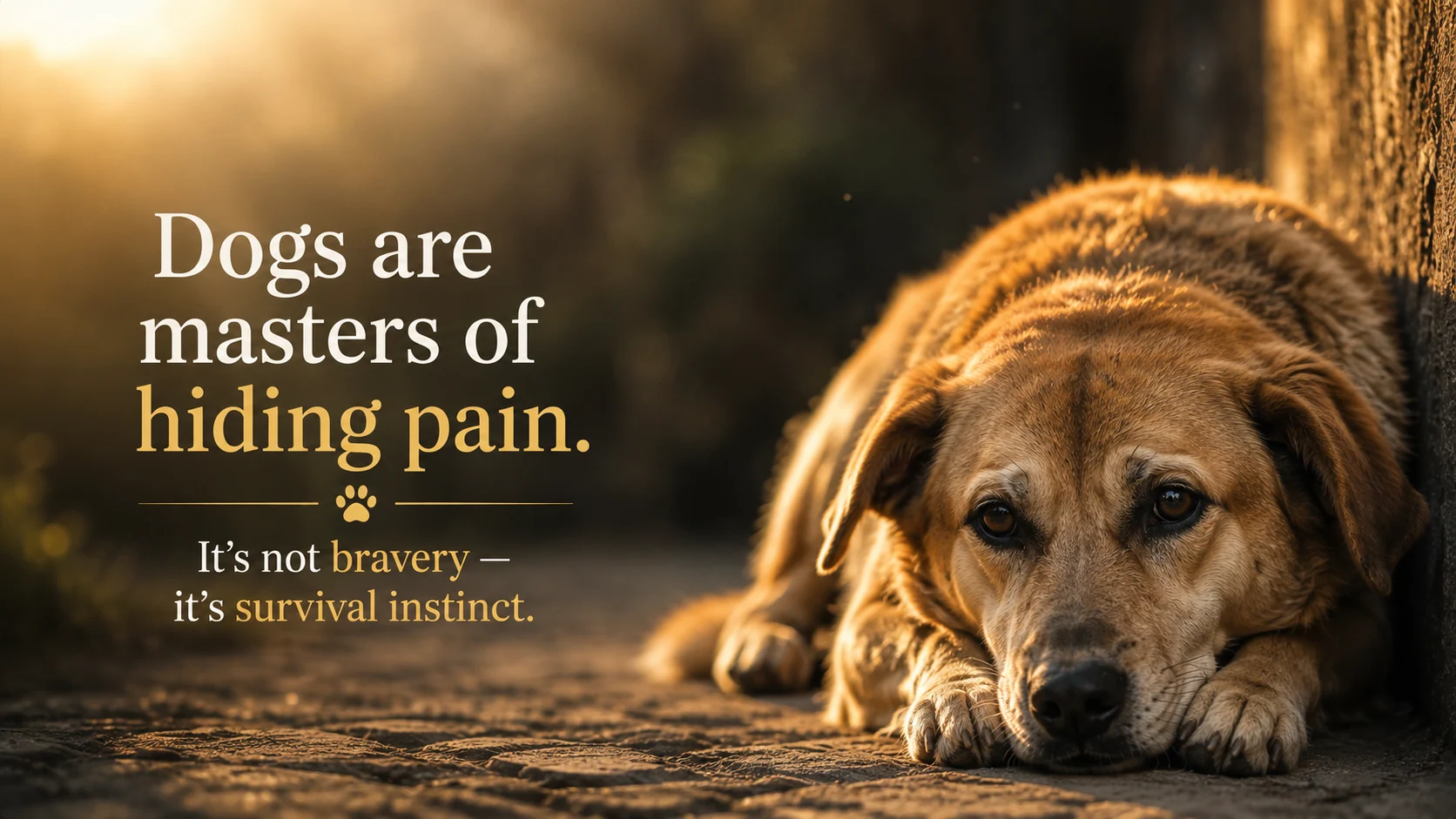
Good. Because dogs are masters of hiding pain. Not because they are brave. Not because they do not feel it. But because millions of years of evolution taught them that showing weakness could cost them their life.
Your dog cannot tell you where it hurts. But they are showing you — in ways that are easy to miss if you do not know what to look for.
This article will help you see what your dog has been trying to say.
Emergency warning: If your dog is unable to stand, is having seizures, has a swollen or rigid abdomen, is crying out continuously, is breathing in severe distress, or has collapsed — this is an emergency. Do not wait. Contact your veterinarian or emergency animal hospital immediately.
Why do dogs hide pain?
This is not stubbornness. It is survival.
Dogs are descended from wolves — social predators who lived and hunted in packs. In the wild, an animal that visibly limps, whimpers or falls behind becomes a target. Predators watch for weakness. Even within the pack, a visibly injured animal risks losing their position in the social hierarchy.
Over thousands of generations, natural selection favoured animals who could mask discomfort and keep functioning despite injury or illness. That instinct did not disappear when dogs moved into our homes and onto our sofas. It is still running in the background — even when the only "predator" in the house is the vacuum cleaner.
This is why a dog can have a fractured tooth, a deteriorating hip joint or a throbbing ear infection and still wag their tail when you walk through the door. They are not fine. They have simply learned, at the deepest biological level, not to advertise it.
A 2026 study published in PLOS One found that fewer than half of dog owners correctly identified subtle behavioural changes as signs of pain. Many early indicators — nighttime restlessness, increased clinginess, subtle changes in activity — were dismissed as mood shifts, personality quirks or "just getting old."
This means that by the time most owners recognise pain, the dog has often been experiencing it for weeks, months or even longer.
The 12 silent signs your dog may be in pain
Pain in dogs rarely looks like what most people expect. There is usually no dramatic yelp, no obvious limp, no howling at the moon. Instead, it shows up as a quiet shift — a change in the small, everyday things that are easy to overlook.
These are the signs veterinarians wish every dog parent knew.
1. Changes in breathing — panting when there is no reason to pant
All dogs pant after exercise or in warm weather. But panting at rest — while lying on a cool floor, in an air-conditioned room, with no obvious trigger — can be a sign of pain, discomfort or internal distress.
Pain activates the sympathetic nervous system, increasing heart rate and respiratory effort. A dog in pain may breathe faster, more shallowly or more heavily than usual.
Watch for panting that seems disproportionate to the situation — especially at night, when the house is quiet and cool. If your dog is panting and restless when they should be sleeping, pain is one of the first things to consider.
Related reading: If your dog's breathing concerns you, our guide on Why Is My Dog Panting So Much? Heat, Pain, Anxiety, Heart Disease & When to See a Vet covers this topic in depth.
2. Excessive licking or chewing of a specific area
Dogs instinctively lick injuries. It is a self-soothing behaviour rooted in biology — saliva contains compounds that provide mild antibacterial action and temporary comfort.
But when a dog repeatedly licks, chews or nibbles at the same spot — a joint, a paw, a section of their flank — they may be trying to address pain that you cannot see. The source of the discomfort may be directly at the licking site (a cut, a hot spot, arthritis in that joint) or it may be referred pain from elsewhere in the body.
Persistent licking of the paws, in particular, is frequently connected to allergies, yeast infections or underlying joint discomfort. If your dog has been fixated on their paws, our guide on Why Is My Dog Licking Their Paws? Allergies, Yeast, Injury, Anxiety & When to See a Vet explains the common causes and when to seek help.
3. Loss of appetite or changes in eating behaviour
A dog in pain often does not feel like eating. Pain suppresses appetite through the same stress pathways that affect humans — when the body is focused on managing discomfort, hunger takes a back seat.
Watch for:
- Skipping meals they normally devour
- Eating significantly less than usual
- Taking longer to finish a meal
- Dropping food or chewing on one side (which may indicate dental or jaw pain)
- Approaching the bowl with interest but then walking away
If your dog has stopped eating or their appetite has changed noticeably, our comprehensive guide on Why Is My Dog Not Eating? Causes, Red Flags, What to Try & When to See a Vet can help you understand the full range of possible causes.
4. Withdrawal, hiding or unusual clinginess
Pain changes behaviour. Some dogs withdraw — retreating to a quiet corner, hiding under furniture, avoiding interaction. Others become unusually clingy, following you from room to room, pressing against your legs, seeking constant physical contact.
Both responses are significant. A dog who suddenly wants to be alone may be protecting themselves. A dog who suddenly cannot leave your side may be seeking comfort and reassurance.
Neither pattern should be dismissed as a mood or a phase — especially if it appears alongside other changes on this list.
5. Changes in posture — the body tells the truth
When a dog is in pain, their posture often changes in ways that are subtle but telling:
- Hunched or arched back — often seen with abdominal or spinal pain
- The "prayer position" — front legs stretched forward, chest low to the ground, hindquarters raised — a classic indicator of abdominal pain, commonly associated with pancreatitis
- Low head carriage — walking with the head held lower than usual can indicate neck pain
- Stiffness or rigidity — holding the body tightly, as if bracing against discomfort
- Guarding — positioning their body to protect a specific area
- Pinned-back ears — ears held flat against the head can reflect pain, anxiety or both
6. Reluctance to jump, climb stairs or play
This is one of the signs most commonly dismissed as "getting old."
A dog who used to leap onto the bed without a second thought but now hesitates at the edge. A dog who used to race up the stairs but now takes them slowly, one at a time. A dog who used to chase the ball endlessly but now watches from a distance after the first throw.
These changes can happen so gradually that owners adapt without realising it. They lower the expectations, adjust the routine, and accept the "new normal" — often without recognising that the dog is in chronic pain.
Osteoarthritis is the most common cause of chronic pain in dogs, affecting an estimated 20 percent or more of the adult dog population, with some studies finding radiographic evidence of joint disease in up to 60 percent of medium-to-large breed dogs. Many of these dogs are never formally diagnosed.
7. Restlessness — cannot get comfortable
A dog in pain may pace, circle, lie down, get up, reposition, lie down again and repeat. They cannot settle because no position relieves the discomfort.
This is particularly common at night, when there are no distractions. If your dog has started pacing or repositioning frequently during the hours they would normally sleep soundly, pain should be considered — especially in older dogs.
8. Aggression or flinching when touched
This is one of the most misunderstood signs.
A normally gentle dog who suddenly snaps, growls or pulls away when you touch a specific area is not being "bad." They are protecting a painful spot. It is a reflexive, defensive response — not a behavioural problem.
Pay attention to exactly where your dog reacts. Does the flinch happen when you touch their hip? Their ear? Their lower back? Their belly? The location of the reaction often points directly to the source of pain.
9. Trembling or shaking
Dogs shake for many reasons — cold, excitement, anxiety, old age. But trembling can also be a direct response to pain, particularly acute or severe pain.
If your dog is trembling and there is no obvious environmental cause, pain should be considered. Trembling combined with other signs on this list — especially panting, withdrawal or appetite loss — strengthens the concern.
10. Whimpering, yelping or unusual vocalisations
Some dogs do vocalise when they are in pain — but it is often misinterpreted or inconsistent.
A yelp when being picked up, a whimper when lying down in a certain position, a groan when standing up after a nap — these are moments when pain breaks through the dog's instinct to hide it. They are brief, often quiet, and easy to miss.
11. Changes in the eyes
Pain can change how your dog's eyes look:
- Squinting or partially closed eyes — especially if one-sided, this can indicate eye pain, a headache or facial discomfort
- Dilated pupils — the stress response triggered by pain can cause the pupils to enlarge
- A glazed or distant look — a dog in chronic pain may seem "checked out" or less mentally present
- Bloodshot eyes — can indicate eye pain or elevated blood pressure from stress
12. Changes in sleep patterns
Pain disrupts sleep. A dog in pain may:
- Sleep significantly more than usual — the body's attempt to heal and conserve energy
- Sleep less, waking frequently or being unable to settle
- Change their preferred sleeping position to avoid putting pressure on a painful area
- Avoid their usual sleeping spot if getting in or out of it has become uncomfortable
Acute pain versus chronic pain — why the difference matters
Acute pain — sudden, sharp and usually obvious
Acute pain comes on quickly and often has a clear cause — a fall, a fight, stepping on something sharp. The signs tend to be dramatic: yelping, limping, holding up a paw, crying when moved.
Acute pain demands immediate attention because it often signals a fracture, a foreign body, bloat (gastric dilatation-volvulus), a ruptured disc (IVDD) or an insect sting.
Chronic pain — slow, silent and far more dangerous
Chronic pain creeps in over weeks or months. It does not announce itself with a yelp. Instead, it erodes your dog's quality of life gradually, one small change at a time.
The most common causes of chronic pain in dogs include:
- Osteoarthritis — the single most common cause of chronic pain, particularly in seniors and large breeds
- Dental disease — 80 to 90 percent of dogs over the age of three have some form of periodontal disease, much of it causing chronic oral pain that goes undiagnosed (Cornell University College of Veterinary Medicine)
- Hip or elbow dysplasia — developmental joint conditions that worsen with age
- Chronic ear infections — recurring infections cause significant ongoing discomfort
- Intervertebral disc disease (IVDD) — particularly common in Dachshunds, Corgis and Beagles
- Cancer — many cancers cause progressive pain that intensifies over time
The danger of chronic pain: Because the changes happen slowly, owners unconsciously adapt. They stop expecting the dog to jump. They shorten the walks. They accept the slower mornings. Over time, a dog's entire life can shrink around their pain — and everyone gets used to the "new normal" without realising what has happened.
Common causes of pain in dogs
Dental and oral disease
The most underdiagnosed source of pain in dogs. Broken teeth, infected gums, tooth root abscesses and advanced periodontal disease can cause significant daily pain — yet most owners never know because dogs continue to eat. Your dog's mouth should be examined by a veterinarian at least once a year. (American Veterinary Dental College)
Arthritis and joint disease
Osteoarthritis is progressive and frequently underdiagnosed because the early signs — mild stiffness, a "warm-up" period after rest, reluctance to jump — are easy to attribute to ageing.
Back and spinal problems
IVDD and other spinal conditions cause pain ranging from mild stiffness to paralysis. Sudden loss of mobility in the hind legs is a veterinary emergency — surgery is most successful within 24 to 72 hours.
Ear infections
Painful and often chronic. Watch for head shaking, scratching at the ear, a tilted head, redness or unusual odour.
Abdominal pain
From pancreatitis, UTIs, foreign bodies, bladder stones or GI inflammation. Bloat (GDV) is a life-threatening emergency requiring immediate surgery.
Summer-specific pain sources
- Paw pad burns from hot pavement
- Heatstroke causing internal organ damage
- Insect stings — bee and wasp stings; allergic reactions can be severe
- Tick-borne illness — Lyme disease causes painful, swollen joints
- Exercise injuries from increased summer activity
How veterinarians assess pain — and how you can help
The Glasgow Composite Pain Scale
The gold-standard clinical tool for assessing acute pain in dogs. Developed at the University of Glasgow, it evaluates vocalisation, attention to a painful area, mobility, response to touch, demeanour and posture.
What you can do at home
Before your appointment, note:
- When you first noticed something different
- Which specific behaviours have changed
- Whether the change is constant or intermittent
- Whether it is worse at certain times of day
- What your dog has stopped doing
- How they react when specific areas are touched
- Good days versus bad days patterns
Take a short video of the concerning behaviour — it shows your vet more than words can describe.
The "touch test"
Run your hands slowly along your dog's body with light, steady pressure. Watch for flinching, tensing, pulling away, lip licking or growling. Note the location. Stop immediately if your dog shows distress. The goal is to gather information, not to diagnose.
What to do if you think your dog is in pain
Safe immediate steps
- Stay calm and observe carefully
- Limit activity — restrict to gentle, short lead walks
- Provide a comfortable, accessible resting space
- Contact your veterinarian with your observations
- Record a video of the behaviour
Safety note — CRITICAL SAFETY WARNING: Never give your dog human pain medication. Ibuprofen (Advil, Nurofen) and acetaminophen (Tylenol, paracetamol) are toxic to dogs. Even a single dose of ibuprofen can cause stomach ulcers and acute kidney failure. Acetaminophen causes severe liver damage and destruction of red blood cells. These medications can kill your dog. Never give another pet's medication either — doses are weight and condition specific.
What your vet may prescribe
Modern veterinary pain management uses a multimodal approach:
- Veterinary NSAIDs — carprofen (Rimadyl), meloxicam (Metacam), firocoxib (Previcox)
- Gabapentin — for chronic or neuropathic pain
- Grapiprant (Galliprant) — newer option with fewer GI side effects
- Tramadol — sometimes included, though recent research questions standalone effectiveness
- Joint supplements, weight management, environmental modifications and physical rehabilitation
Complementary therapies
- Veterinary acupuncture — safe adjunct for chronic pain (AAHA; WSAVA)
- Laser therapy (photobiomodulation) — supported by research for inflammation and tissue repair
- Hydrotherapy — low-impact exercise and pain relief for joint disease
- Physical rehabilitation — structured programmes under certified practitioners
When to rush to the vet — the emergency guide
Immediate emergency — go now
- Cannot stand or sudden loss of hind leg function
- Swollen, hard abdomen with retching (possible bloat/GDV)
- Continuous crying or screaming
- Seizure with pain signs
- Suspected toxin ingestion
- Severe breathing distress
- Collapse or unconsciousness
Urgent — within 24 hours
- Persistent limping not improving with rest
- Food refusal beyond 24 hours (12 hours for puppies/seniors)
- Vomiting or diarrhoea combined with pain signs
- Sudden reluctance to move, jump or climb
- Painful reaction to touch in a specific area
Schedule a visit — this week
- Gradual reduction in activity or playfulness
- Progressive stiffness over days or weeks
- Repeated licking/chewing of one area
- Sleep pattern changes
- Subtle behavioural shifts persisting more than a few days
Frequently asked questions
How do I know if my dog is in pain or just tired?
Tiredness resolves with rest. A tired dog recovers within hours. A dog in pain does not return to baseline — the changes persist. If "tiredness" lasts more than a day or two, or is accompanied by other signs, pain should be considered.
Can dogs cry tears from pain?
Dogs do not produce emotional tears. Watery eyes indicate an eye condition, irritation or allergy. However, dogs do vocalise — whimpering, yelping and groaning are pain expressions.
Is my senior dog too old for pain medication?
Age alone is not a reason to withhold pain relief. Many seniors benefit enormously from properly managed medication. Your vet will assess liver and kidney function for safety. Living with untreated chronic pain is not acceptable.
My dog seems fine but is stiff in the morning. Is that pain?
Very likely. Morning stiffness improving after movement — the "warm-up effect" — is a hallmark of osteoarthritis. The underlying joint disease is present and progressing. Discuss with your vet.
Should I let my dog rest or keep them moving?
For acute injuries, rest is essential. For chronic conditions like arthritis, gentle controlled movement is often better than complete rest. Your vet can advise the right balance.
Can anxiety cause symptoms that look like pain?
Yes. Anxiety and pain share many signs — panting, restlessness, withdrawal, appetite loss. Professional assessment distinguishes between them. Our guide on Dog Separation Anxiety: Signs, Causes, What Actually Works & When to See a Vet covers anxiety in depth.
You know your dog better than anyone
There is no blood test for "something seems off." There is no X-ray that captures the way your dog hesitated at the bottom of the stairs this morning, or the way they looked at you when you touched their hip.
But you saw it. You noticed. And that matters more than you might think.
Veterinarians rely on owners to be the first line of detection — because the subtle, everyday changes that signal pain are almost always visible at home long before they appear in a clinical setting.
Pain is not a normal part of ageing. Slowing down is not inevitable. And "they are just getting old" is not a diagnosis. If your dog's life has quietly become smaller — fewer walks, less play, more sleeping, less joy — ask the question: could they be in pain? The answer might change everything.
You do not need to have all the answers. You just need to notice the change, write down what you have seen and bring it to your veterinarian. That is what thoughtful, attentive dog parents do — and the fact that you read this far tells me you are already one of them.
Stay Ahead of Hidden Health Changes
Pain often starts with small, easy-to-miss changes. Use Raise Happy Dog's free tools to track your dog's wellness and catch the subtle shifts before they become serious.
Check Your Dog's Score Free Care Reminder
Important medical disclaimer
This article provides general educational information and does not replace examination, diagnosis or treatment by a qualified veterinarian. Pain in dogs can have many causes, some of which are medical emergencies. If your dog is showing signs of severe pain, has suddenly lost mobility, or if you are concerned for any reason, please consult your veterinarian immediately.
Found this helpful? Share it with a fellow dog parent:
References & trusted sources
- Cornell University College of Veterinary Medicine — Pain Recognition in Dogs; Canine Health Topics
- American Animal Hospital Association (AAHA) — 2022 Pain Management Guidelines for Dogs and Cats
- World Small Animal Veterinary Association (WSAVA) — Guidelines for Recognition, Assessment and Treatment of Pain
- University of Glasgow — Glasgow Composite Measure Pain Scale
- American Veterinary Dental College — Periodontal Disease in Dogs
- American Veterinary Medical Association (AVMA) — Pain Management in Animals
- PetMD — Signs of Pain in Dogs
- Merck / MSD Veterinary Manual — Pain Assessment and Management
- NIH / PubMed — Peer-reviewed research on canine pain, osteoarthritis and multimodal analgesia
- PLOS One — The abilities in dog pain sign recognition as assessed by dog owners and non-dog owners (2026)
- Texas A&M College of Veterinary Medicine — Osteoarthritis as the most common cause of chronic pain in pets
Keep your dog's care organized
The Complete Dog Care Planner turns all of this into one calm, simple routine you can actually stick to.