Why Does My Dog Eat Grass? The Science Behind One of Nature’s Most Curious Habits
The reassuring truth is far more fascinating than most pet parents expect
It’s one of the most searched dog questions in the world. Drawing on two decades of veterinary and behavioral research — including the landmark UC Davis study of 1,571 dog owners — here is what science actually says.
12 min readJuly 2026 Creative Foundation
Share
You’ve seen it a hundred times. You’re out on a morning walk — the air still carrying the coolness of dawn, the leash loose in your hand — and your dog suddenly stops. Not to sniff a post. Not to investigate a stranger. But to lower their head into a tuft of fresh grass and begin eating it, deliberately and methodically, as if they’d been waiting for this moment all day.
And every time, the same quiet worry surfaces in your mind: Is something wrong? Are they sick? Should I stop them?
You’re not alone. It’s one of the most searched dog-related questions on the internet, asked by millions of pet parents across the world every single year. And the truth — as science has slowly uncovered over the last two decades — is far more fascinating, and far more reassuring, than most people expect. Let’s walk through it together.
The Big Myth: “They Eat Grass Because They’re Sick”
For decades, the prevailing wisdom — passed from one pet parent to the next, even echoed by some veterinary professionals — was simple and definitive: dogs eat grass to make themselves vomit when they feel unwell. It sounds logical. It feels intuitive. And it’s largely wrong.
The most comprehensive scientific investigation into canine grass-eating was conducted by Dr. Karen Sueda, Dr. Benjamin Hart, and Dr. Kelly Cliff at the University of California, Davis, published in Applied Animal Behaviour Science in 2008. Their team surveyed 1,571 dog owners — one of the largest samples ever collected on this subject — and what they found overturned the old narrative.
Finding
Percentage
Dogs that showed no signs of illness before eating grass
91%
Dogs that did not vomit after eating grass
78%
Dogs observed eating grass regularly as a recurring behavior
68%
Read those numbers again. Ninety-one percent of dogs showed no sign of feeling unwell before they began to eat grass. And nearly four out of five didn’t vomit afterward. The researchers concluded — carefully, and with the caution that marks good science — that grass-eating in domestic dogs is a common, normal behavior, not a symptom of illness, not a distress signal, and not a desperate attempt at self-medication.
When vomiting did occur, it was more likely a coincidental consequence of the physical irritation caused by the grass blades in the stomach, rather than the dog’s deliberate intent.
“The behavior appears to be a common one in dogs, not typically accompanied by signs of illness and rarely associated with vomiting.”
This is where the story becomes beautiful — because the answer doesn’t live in a veterinary clinic. It lives in the forests and grasslands of a world that existed thousands of years before your dog ever curled up at the foot of your bed. Here are the six leading explanations.
01
Evolutionary Instinct
An Echo from Their Ancestors
Not the carnivores we imagine
Your dog, no matter how small their paws or how soft their bed, carries inside them the genetic memory of wolves. And wolves — despite their reputation as fearsome, meat-driven predators — are not strict carnivores. They are opportunistic feeders with a diet far more varied than most people imagine.
What the field studies show
Field studies of wild wolf populations — including research published in the Canadian Journal of Zoology and observations from places like Yellowstone National Park — have consistently documented that plant material, including grasses, berries, and sedges, makes up a small but regular portion of the wild wolf diet. Wolves don’t eat plants out of desperation; they eat them as part of the natural rhythm of their feeding.
What you can do
When your dog lowers their head into the grass, they may be listening to a voice that is thousands of years old — an instinct already ancient when the first wolves began walking beside early humans some 13,000 to 40,000 years ago. This isn’t a disorder. It’s a heritage.
Source: Canadian Journal of Zoology; International Wolf Center & Yellowstone Wolf Project.
02
Evolutionary Biology
The Parasite-Purging Hypothesis
An ancient defense
One of the most elegant theories in veterinary evolutionary biology links grass-eating to an ancient defense against intestinal parasites. In the wild, where deworming medication didn’t exist, canids who consumed rough, fibrous plant material gained a survival advantage. The coarse edges and fibrous composition of grass blades could increase intestinal motility — the muscular contractions that move material through the gut — and potentially help wrap around and expel parasitic worms like nematodes.
Evidence from our primate cousins
This theory is supported by fascinating parallel research on our closest relatives. Dr. Michael Huffman and other primatologists have extensively documented zoopharmacognosy — animals self-medicating with plants — in wild chimpanzees. Chimps in Tanzania and Uganda swallow specific rough-textured leaves whole, without chewing, and later pass them alongside expelled parasites. The tiny hooked hairs (trichomes) on these leaves physically snag and dislodge intestinal worms as they pass through the gut.
What you can do
While dogs today — especially those on regular deworming protocols — rarely need this defense, the instinct may still whisper in their biology. It is an old solution to an old problem, and evolution does not discard instincts quickly.
Source: Huffman, M.A., Yearbook of Physical Anthropology (1997).
03
Digestive Health
The Fiber and Roughage Factor
An overlooked essential
Grass is, at its core, a source of insoluble dietary fiber — and fiber is one of the most important, if unglamorous, components of a healthy digestive system. Insoluble fiber adds bulk to stool, promotes regular bowel movements, and helps maintain healthy motility through the gastrointestinal tract. For a dog whose diet is low in fiber, a mouthful of grass may be the simplest, most intuitive answer.
A telling case study
One remarkable case study, published in the Journal of Veterinary Medical Science and indexed on PubMed, described a miniature poodle that had engaged in compulsive plant-eating for seven years. After veterinarians switched the dog to a high-fiber diet, the behavior stopped within three days — and did not return during follow-up.
One case study does not make a universal rule. The vast majority of dogs on balanced, complete commercial diets do not eat grass because of a fiber deficiency. But for some individuals, the connection between the gut and the blade of grass may be more direct than we once assumed.
Source: Journal of Veterinary Medical Science (indexed on PubMed/NIH).
04
Emerging Science
The Emerging Microbiome Connection
The invisible ecosystem
In recent years, veterinary science has begun to explore one of the most exciting frontiers in animal health: the gut microbiome — the trillions of bacteria, fungi, and microorganisms that live in the digestive tract and profoundly influence digestion, immunity, mood, and even behavior.
Grass as a prebiotic?
While research specifically linking grass consumption to microbiome modulation in dogs is still early, a compelling hypothesis has emerged: the fiber in grass may act as a prebiotic — a substrate that feeds beneficial gut bacteria and helps maintain microbial diversity. We know from human and veterinary microbiome research (in journals including Nature Reviews Microbiology) that dietary fiber directly shapes the gut microbial community. A dog reaching for grass may, in some cases, be reaching for something that nourishes the invisible ecosystem inside them.
What you can do
It’s speculative. It’s early. And it’s beautiful — a reminder of how much we are still learning about the inner workings of the animals we love.
Sometimes, your dog eats grass because they enjoy it. Veterinary behaviorists have observed that many dogs show a clear preference for young, fresh, springtime grass — the tender, moist shoots that emerge after rain or in early morning dew. These blades are sweet, cool, and texturally satisfying, much like a fresh salad might be to a human on a warm afternoon.
What you can do
Dogs are sensory creatures, experiencing the world through taste, texture, and scent with a richness we can barely imagine. The idea that a mouthful of dewy grass might be, quite simply, pleasant — is perhaps the most honest explanation of all.
Source: Observations by veterinary behaviorists; VCA Animal Hospitals; PetMD.
06
Behavior & Wellbeing
Boredom, Anxiety, and the Need to Do Something
Built for purpose
Dogs are active, intelligent animals built for purpose. In the wild, their ancestors spent most of their waking hours hunting, foraging, exploring, and navigating complex social hierarchies. A domestic dog — especially one who spends long hours alone or under-stimulated — may turn to grass-eating as a form of displacement behavior: a way to occupy their mouth, their mind, and their time when there’s nothing else to do.
Most common in
This behavior appears most often in certain groups of dogs:
What you can do
Young dogs and puppies — who explore the world orally as a natural developmental behavior
High-energy breeds — that aren’t receiving sufficient physical exercise
Dogs experiencing anxiety — from separation, environmental change, or social stress
If your dog eats grass compulsively, rapidly, or in a frenzied manner — especially when alone or during stressful situations — this may be a behavioral signal worth discussing with your veterinarian or a certified animal behaviorist.
Source: University of Wisconsin School of Veterinary Medicine; PetMD.
What the Science Says at a Glance
Theory
Scientific Support
Key Evidence
Self-induced vomiting when sick
❌ Largely debunked
UC Davis (2008): 91% showed no illness; 78% didn’t vomit
Ancestral instinct from wild canids
✅ Well-supported
Wolf diet studies document regular plant consumption
Parasite purging mechanism
✅ Plausible (evolutionary)
Zoopharmacognosy research in primates; fiber increases motility
Dietary fiber / roughage need
✅ Supported in some cases
Published case study: poodle behavior resolved with high-fiber diet
Gut microbiome support
🔬 Emerging hypothesis
Prebiotic role of dietary fiber in microbiome research
Taste and sensory enjoyment
✅ Widely observed
Preference for young, fresh grass documented by behaviorists
Boredom / anxiety behavior
✅ Behaviorally supported
More common in understimulated, anxious, or young dogs
Read This Carefully
The Hidden Danger That Has Nothing to Do with Grass
Here’s the part that many articles overlook — and it matters deeply. The grass itself is almost never the problem. But what’s ON the grass can be.
Pesticides, Herbicides, and Lawn Chemicals
Lawns treated with chemical pesticides, herbicides (particularly those containing 2,4-Dichlorophenoxyacetic acid, commonly known as 2,4-D), and synthetic fertilizers pose a very real risk to dogs who graze. Research in environmental and veterinary toxicology journals has linked exposure to common lawn chemicals to:
Long-term cancer risk: a statistically significant association between herbicide-treated lawns and increased risk of canine malignant lymphoma and bladder cancer (transitional cell carcinoma)
Contact dermatitis: skin irritation on paws, legs, and underbelly from walking on recently treated surfaces
What You Can Do
Action
Details
Know your lawn
If you treat your own lawn, choose pet-safe products and follow re-entry guidelines (minimum 48 hours).
Be cautious in public spaces
Parks, golf courses, and commercial properties are frequently treated with chemicals.
Rinse after walks
Wipe or wash your dog’s paws after walking on unfamiliar grass.
Supervise grazing
If your dog is a committed grass-eater, redirect them to areas you know are untreated.
Grow a “safe patch”
Some pet parents grow a small patch of untreated wheatgrass or barley grass specifically for their dogs.
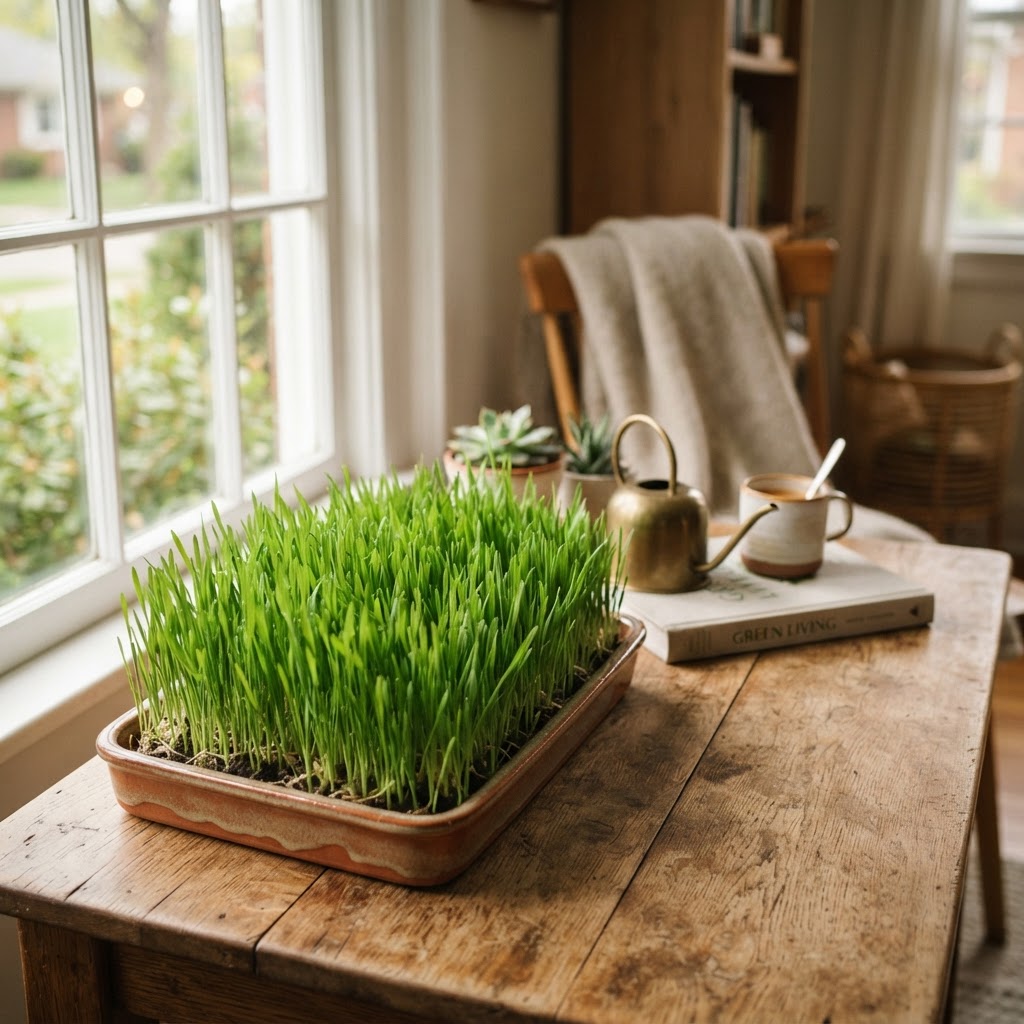
A home tray of pesticide-free wheatgrass gives committed grazers a safe, toxin-free alternative.
Toxic Plants Hiding in the Grass
Beyond chemicals, many common garden and wild plants that grow alongside grass can be toxic to dogs. Be mindful of:
Foxtails — barbed grass awns that can lodge in ears, nose, eyes, and paws
Mushrooms — many wild varieties are highly toxic
Ornamental plants mixed into lawns — azaleas, oleander, sago palms
Slug and snail bait — metaldehyde-based baits are extremely dangerous
When Should You Actually Worry?
Occasional grass-eating in an otherwise healthy, happy dog is — by every measure science has given us — normal. It is not a disease. It is not a deficiency. In the vast majority of cases, it is simply a dog being a dog. But you should consult your veterinarian if you notice:
Sudden onset of grass-eating in a dog who never showed the behavior before
Frantic, compulsive, or obsessive eating as if driven by an uncontrollable urge
Frequent vomiting after eating grass especially if it contains blood or bile
Loss of appetite for regular food, while continuing to eat grass
Accompanying symptoms such as lethargy, diarrhea, weight loss, abdominal discomfort, or behavioral changes
Pica consuming non-food items beyond grass (rocks, dirt, plastic, fabric), which can indicate GI disease, nutritional deficiency, or psychological distress
What You Can Do as a Thoughtful Pet Parent
1
Review Their Diet
Ensure your dog eats a complete and balanced diet for their age, breed, and activity level. If you suspect a fiber deficiency, ask your vet about cooked pumpkin (a gentle source of soluble and insoluble fiber), steamed green beans, or specialized digestive-health / high-fiber formulas.
2
Increase Mental and Physical Stimulation
If boredom or anxiety may be a factor: extend and vary walks, introduce puzzle feeders and enrichment toys, practice mind-engaging training exercises, and consider doggy daycare or a walking companion for dogs alone for long hours.
3
Offer a Safe Alternative
If your dog simply loves to chew on greens, grow a small tray of wheatgrass or barley grass at home — pesticide-free, toxin-free, and always available.
4
Keep Parasite Prevention Current
Keep your dog on an appropriate, vet-recommended deworming and parasite-prevention schedule. The parasite-purging instinct may still be present, but the actual need for it should be managed medically.
5
Monitor, Don’t Panic
Most of the time, the best thing you can do is observe. Watch for patterns — before meals? during walks? when left alone? — and note any other changes. This information is invaluable if you decide to consult your vet.
A Final Thought
There is something quietly moving about watching a dog eat grass. It’s a moment where the line between the domestic and the wild becomes beautifully thin — where the companion curled at your feet reveals, for just a second, that they are still connected to something ancient and untamed. That somewhere inside the gentle creature who brings you their toy and rests their head on your lap, there lives the memory of forests, of open plains, of a time before leashes and living rooms.
They eat grass not because something is broken. They eat it because something is still whole.
And that — perhaps more than any statistic or study — is the most important thing to understand.