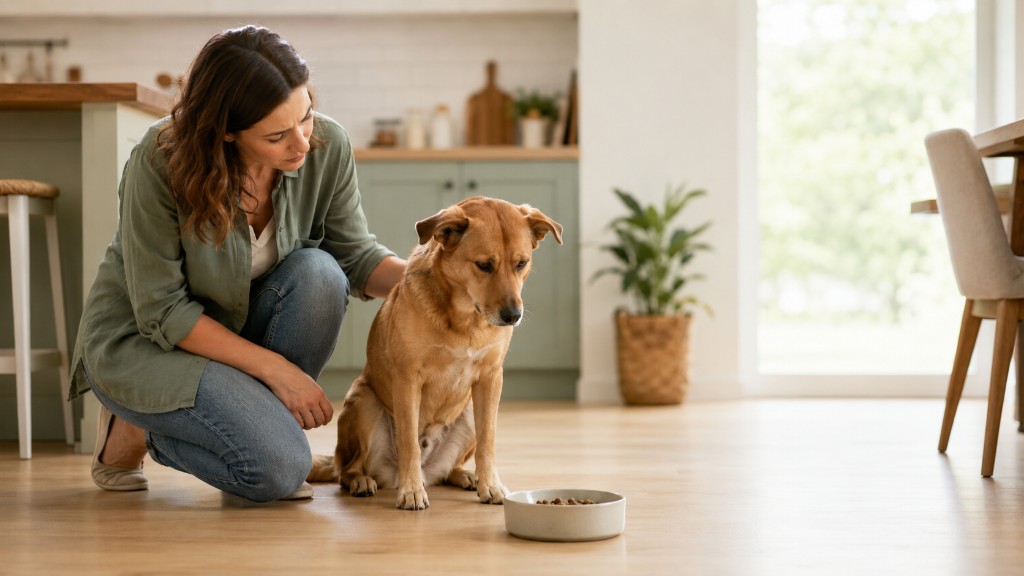
Dog Separation Anxiety: Signs, Causes, What Actually Works & When to See a Vet
Separation anxiety is not a behaviour problem — it is a panic disorder. Learn how to recognise the signs, understand the science, and help your dog feel safe when you are not home.
Written by the Raise Happy Dog editorial team. Educational only — not a substitute for your veterinarian. Read our editorial policy.

You come home and the door frame is gouged with claw marks. The curtains are torn down. There is a puddle near the entrance, even though your dog has been perfectly house-trained for years.
Your neighbours mention the barking — not the kind that stops after a few minutes, but the kind that sounds like distress. Like an animal that genuinely believed it had been abandoned.
And when you open the door, your dog does not simply greet you. They crash into you. They tremble. They press against your legs as though you have just returned from the other side of the earth.
This is not disobedience. This is not revenge for being left behind. This is not your dog "acting out."
This is separation anxiety — and if it sounds like panic, that is because it is.
If your dog is injuring themselves during escape attempts, refusing food when alone, or showing signs of extreme distress such as prolonged trembling, vomiting or self-harm, contact your veterinarian or a veterinary behaviourist urgently. Separation anxiety can escalate and cause serious physical and emotional harm.
What separation anxiety actually is
Separation anxiety is a clinical behavioural condition in which a dog experiences significant emotional distress — sometimes resembling a full panic attack — when separated from the person or people they are most attached to. (ASPCA)
It is not the same as boredom. It is not a training failure. It is not spite.
Veterinary behaviourists now understand it as a panic disorder — a condition in which the dog's brain perceives separation as a genuine threat to survival. The distress is involuntary, neurochemical, and completely outside the dog's conscious control. (AVMA)
And it is far more common than many owners realise. Research suggests that between 20% and 40% of dogs presented to behaviour clinics are diagnosed with separation-related problems. A major 2026 study from the Dog Aging Project, using data from over 43,000 dogs, found that more than 84% of dogs exhibited at least mild signs of fear or anxiety in everyday situations. (Texas A&M / Dog Aging Project)
Among puppies specifically, the Royal Veterinary College's Generation Pup study found that approximately 40–50% showed signs of separation-related distress by six months of age. (RVC Generation Pup)
If you are reading this because your dog struggles when you leave, know that you are not alone — and neither is your dog.
The signs: what separation anxiety looks like
Separation anxiety does not always look dramatic. Some dogs destroy furniture. Others simply pace. Some suffer silently with elevated heart rates and stress hormones that no one sees because no one is home to witness them.
The defining feature is that these behaviours happen only — or primarily — when the dog is alone or separated from their attachment figure. If the behaviour also occurs when you are home, there may be a different explanation.
Common signs
Watch for any of the following when you are away — or in the minutes before you leave:
- Destructive behaviour — chewing, scratching or digging at doors, windows and exit points. This is often focused specifically on barriers between the dog and the outside world, not random household objects. (ASPCA)
- Persistent vocalisation — barking, howling or whining that begins shortly after you leave and does not stop. This is not the territorial bark at a passing stranger — it is the sound of a dog who is frightened.
- House soiling — urination or defecation indoors, even in dogs who are completely house-trained. This occurs because the dog's autonomic nervous system is overwhelmed. (VCA Hospitals)
- Pacing — walking back and forth in fixed patterns, often along the same route, repeatedly.
- Excessive drooling or panting — signs of autonomic arousal driven by the stress response.
- Escape attempts — sometimes extreme enough to break teeth, tear nails, cut paws or damage doors and windows. These are not acts of defiance; they are attempts to reach the person the dog depends on.
- Pre-departure anxiety — restlessness, whining, panting or shadowing that begins when you pick up your keys, put on shoes or reach for your coat.
- Refusal to eat — many dogs with moderate to severe separation anxiety will not eat when alone, even if high-value food or treats are left for them. (ASPCA)
What you might notice when you return
- Your dog greets you with overwhelming intensity — jumping, trembling, whining — far beyond normal enthusiasm.
- It takes your dog a long time to calm down and settle after you arrive home.
- You find evidence of distress — destroyed items near exits, drool marks, displaced bedding, scratched surfaces.
If you are unsure whether your dog's behaviour qualifies as separation anxiety, set up a camera or phone to record them while you are away. What you see may surprise you — and it will help your veterinarian make an accurate diagnosis. (Today's Veterinary Practice)
What it is not: ruling out other explanations
Before concluding that your dog has separation anxiety, it is important to distinguish it from other issues that can look similar.
Boredom or insufficient exercise
A dog who chews cushions, raids bins or digs in the garden may simply be under-stimulated. The key difference: a bored dog does not typically show pre-departure anxiety, does not focus destruction on exit points, and often engages in these behaviours even when you are home.
Incomplete house training
A dog who occasionally urinates indoors may not be fully house-trained. If the soiling happens both in your presence and absence, separation anxiety is less likely.
Noise phobia or other fears
Some dogs become distressed in response to thunder, construction noise, sirens or other sounds that occur while you are away. The trigger is the noise, not your absence.
Medical conditions
Urinary tract infections, gastrointestinal illness, medication side effects, age-related cognitive decline and hormonal conditions such as Cushing's disease can all produce symptoms that overlap with separation anxiety. Always consult your veterinarian first to rule out medical causes. (ASPCA)
Why does separation anxiety develop?
There is no single cause. Separation anxiety arises from a combination of genetics, temperament, early life experiences and environmental triggers — often layered on top of each other.
The science underneath
Dogs are social animals. They evolved alongside humans and are neurobiologically wired for attachment. When that attachment bond is disrupted or threatened, the brain responds the same way it would to a survival-level threat.
The hypothalamic-pituitary-adrenal (HPA) axis activates. The hypothalamus signals the pituitary gland, which instructs the adrenal glands to flood the body with cortisol — the primary stress hormone. Heart rate increases. Blood pressure rises. The dog enters a state of fight-or-flight that it cannot reason its way out of. (NIH / Peer-reviewed research)
In dogs with separation anxiety, this system can become chronically overactivated. The negative feedback loop that normally shuts off the stress response weakens, leaving the dog in a persistent state of heightened anxiety — sometimes even between episodes.
The amygdala (the brain's fear centre) and hippocampus (which processes memory) often show hyperactivity during separation. The neurotransmitter systems that regulate mood — particularly serotonin and dopamine — may be imbalanced, making the dog more vulnerable to panic.
This is why veterinary behaviourists compare canine separation anxiety to human panic disorder. The behaviours are not choices. They are the physical manifestations of an involuntary neurological event. (Zomedica / Veterinary Research)
Known risk factors
| Risk Factor | How It Contributes |
|---|---|
| Rehoming, shelter stays or abandonment | Dogs who have lost a primary attachment figure are significantly more likely to develop separation anxiety. Shelter dogs are overrepresented in diagnosed cases. (ASPCA) |
| Abrupt changes in routine | A guardian who previously worked from home and now returns to an office. A family member who moves out. A sudden shift in when or how long the dog is left alone. (ASPCA) |
| Moving to a new home | A change in environment can destabilise a dog's sense of security. |
| Genetics and temperament | Traits linked to fearfulness and attachment are heritable. Some dogs are born with a higher baseline for anxiety. (AVMA) |
| Early weaning or inadequate socialisation | Puppies separated from the dam before eight weeks, or those who missed critical socialisation windows, may develop lower stress tolerance and greater dependency. (Purdue University) |
| Hyper-attachment | Dogs who follow their owner from room to room, become visibly distressed during even brief separations (such as a closed bathroom door), and display excessive greeting behaviour are at higher risk. |
| Aversive training methods | Research has linked punishment-based training to increased anxiety. Positive reinforcement-based training builds resilience. (RVC) |
What the Generation Pup study tells us
The Royal Veterinary College's Generation Pup longitudinal study — one of the largest puppy research projects of its kind — tracked puppies from birth and identified several early-life factors strongly associated with separation-related behaviours:
- Crate confinement without gradual conditioning was a significant risk factor. Crates used as default containment rather than carefully introduced safe spaces increased the likelihood of separation distress. Open playpens were found to be a more suitable alternative for many puppies.
- Puppies left alone for more than one hour within the first two weeks of arriving in their new home were at significantly higher risk. The puppy's nervous system needs time to develop a "secure base" before independence training begins.
- Inadequate sleep increased risk. Puppies with nine or more hours of sleep per night at 16 weeks were less likely to develop separation-related behaviours.
- Excessive fussing upon return — owners who responded to unwanted behaviour with intense attention when they came home — were found to have puppies six times more likely to display separation-related problems.
- Aversive methods — including scolding or physical punishment — were linked to higher rates of separation distress. (RVC Generation Pup / NIH)
Emergency warning: contact your vet if you notice severe or worsening symptoms.
What actually works: evidence-based treatment
There is no overnight cure for separation anxiety. But there is a clear, evidence-based path forward — and many dogs improve significantly with the right approach.
The most effective treatment combines behaviour modification, environmental management and, when necessary, medication. These three elements work together. Removing any one of them often slows or stalls progress. (AAHA)
1. Systematic desensitisation
This is the foundation of treatment. The goal is to gradually teach your dog that being alone is safe — by exposing them to very short separations that do not trigger anxiety, and then slowly increasing the duration over time.
How it works:
- Begin with absences so brief that your dog does not have time to become anxious — even if that means stepping out of the room for just two seconds and returning.
- Gradually increase the duration in very small increments. Increase by a few seconds at a time. If your dog shows any signs of distress, go back to a shorter duration and progress more slowly.
- The critical rule: your dog must remain calm during every practice session. If they become anxious, the separation was too long. (ASPCA)
- Most dogs' anxious responses occur within the first 40 minutes. Building up to 40-minute absences may take several weeks. Once your dog can handle 40 minutes calmly, you can begin increasing in larger increments — first five minutes, then fifteen.
- Once a dog can remain calm for approximately 90 minutes, most can handle four to eight hours. (ASPCA)
What this looks like in practice:
Step one — work on out-of-sight stays inside the home. Ask your dog to stay while you step behind a bathroom door. Return before they become anxious.
Step two — extend these exercises to a bedroom door, then eventually to the front or back door.
Step three — once your dog is comfortable with the "stay game," begin incorporating very short actual departures. Leave for one to two seconds, return calmly.
Step four — pair departures with something positive (a stuffed food toy given just before you step out). This becomes a safety signal — it tells your dog that this separation is predictable and safe.
2. Counterconditioning
Counterconditioning changes the emotional association your dog has with being alone — from fear to comfort.
- Every time you leave, offer a high-value food puzzle (such as a stuffed Kong frozen with peanut butter, cottage cheese or canned dog food) that takes 20–30 minutes to finish.
- Remove the puzzle when you return, so that your dog only receives it when alone. This teaches the dog that your departure predicts something wonderful.
- Important caveat: this strategy works well for mild separation anxiety. Dogs with moderate or severe anxiety often will not eat when their person is absent. (VCA Hospitals)
3. Managing departure cues
Many dogs begin to panic the moment they recognise the signs that you are about to leave — picking up keys, putting on shoes, reaching for a bag.
You can reduce this pre-departure anxiety by desensitising your dog to these cues:
- Pick up your keys — and then sit down to watch television.
- Put on your shoes and coat — and then walk to the kitchen and make tea.
- Open the front door — and then close it and remain inside.
Repeat these "fake" departures many times a day over several weeks. Your dog will gradually learn that these signals do not always mean you are leaving. (ASPCA)
4. Calm arrivals and departures
One of the simplest and most important changes you can make:
- When you leave, keep it quiet. A calm pat, a brief goodbye, and go.
- When you return, wait until your dog has settled before giving attention. Greet them quietly. If they are frantic, ask them to sit or perform a familiar behaviour before engaging.
This reduces the emotional contrast between your presence and your absence — making both states feel more normal. (ASPCA)
5. Building independence at home
Even when you are home, practise small separations:
- Encourage your dog to rest in a different room while you work.
- Reward your dog for settling on their own bed or mat, even when you are nearby.
- Avoid following your dog everywhere (or allowing your dog to follow you everywhere) without pause.
The goal is not to withdraw affection — it is to help your dog develop the emotional resilience to feel secure even when you are not within sight. (VCA Hospitals)
6. Physical exercise and mental enrichment
A tired, mentally satisfied dog copes better with alone time:
- Provide at least 30 minutes of aerobic exercise (running, swimming, active play) before planned absences.
- Use food puzzles, snuffle mats, scent games and training sessions to engage your dog's mind.
- Vary your walking routes so your dog encounters novel smells and environments. (ASPCA)
These strategies support treatment but are not a substitute for desensitisation and behaviour modification.
When medication helps — and why it is not a failure
There is a persistent misconception that medicating a dog for anxiety is giving up, or that it means the owner has not tried hard enough.
That is simply not true.
Some dogs are so overwhelmed by their anxiety that their brain cannot learn new associations while in that state. They are too flooded with cortisol, too consumed by panic, to absorb the lessons that behaviour modification is trying to teach.
Medication does not "cure" separation anxiety. What it does is lower the dog's baseline stress level so that their brain becomes receptive to learning. It creates a window of calm within which desensitisation can actually take effect. (AAHA)
Medications currently used for canine separation anxiety
| Medication | Type | Notes |
|---|---|---|
| Fluoxetine (Reconcile) | Selective serotonin reuptake inhibitor (SSRI) | FDA-approved for canine separation anxiety. Used alongside a behaviour modification programme. Takes several weeks to reach full effect. |
| Clomipramine (Clomicalm) | Tricyclic antidepressant | FDA-approved for canine separation anxiety. Also used in combination with behaviour modification. |
| Tasipimidine (Tessie) | Alpha-2 adrenoceptor agonist | FDA-approved in May 2026 — the first medication specifically labelled for both noise aversion and separation anxiety in dogs. Works by reducing the sympathetic "fight or flight" response. |
| Trazodone | Serotonin antagonist and reuptake inhibitor | Not FDA-approved for veterinary use, but widely prescribed off-label for anxiety, including separation-related distress. Often used as a short-term situational aid alongside daily medications. |
Never give your dog human medication without veterinary guidance. Dosages, interactions and safety profiles are different for dogs. Always work with your veterinarian or a veterinary behaviourist when considering pharmaceutical support. (ASPCA)
What NOT to do
These approaches do not work. Some of them will make your dog's condition significantly worse.
Do not punish your dog
Scolding, shouting at, or physically correcting a dog for separation-related behaviours will increase their anxiety. They are not misbehaving — they are panicking. Punishment adds fear on top of fear and can permanently damage the trust your dog has in you. (ASPCA)
Do not use "tough love" or force them to "get used to it"
Leaving a severely anxious dog alone for hours in the hope that they will eventually adjust is called flooding — and it is the opposite of what works. It does not build tolerance; it deepens the trauma. During treatment, your dog should never experience a full-blown panic episode if it can be avoided. (ASPCA)
Do not assume a crate will solve the problem
For some dogs, a crate can be a comforting den-like space — but only if the dog has been positively conditioned to it. For a dog with separation anxiety, a crate can become a cage of panic, leading to frantic escape attempts, broken teeth and self-injury. If your dog shows signs of distress in a crate (heavy panting, excessive drooling, frantic scratching, persistent barking), stop using the crate immediately. A baby gate or open playpen is often a better option. (ASPCA)
Do not get a second dog as a "fix"
Separation anxiety is about attachment to a specific person, not about being alone in general. While a companion animal may help in some cases, it is not a reliable treatment — and it may simply give you two stressed dogs instead of one. (VCA Hospitals)
When to see a veterinarian or behaviourist
Seek professional help if:
- Your dog is injuring themselves during escape attempts.
- Destructive behaviour is severe or worsening.
- Your dog is not eating when alone.
- You have been working on desensitisation for several weeks without progress.
- Your dog's distress is so severe that you cannot leave the house without significant consequences.
- You are unsure whether the behaviour is separation anxiety or a medical condition.
- You feel overwhelmed, frustrated or guilty — and you need support.
Who to look for
- A veterinary behaviourist (Diplomate of the American College of Veterinary Behaviorists — DACVB). These are veterinarians with board-certified specialisation in behaviour who can prescribe medication and design comprehensive treatment plans.
- A Certified Applied Animal Behaviorist (CAAB or ACAAB). These professionals hold advanced degrees in animal behaviour.
- A Certified Separation Anxiety Trainer (CSAT). These trainers have specific, in-depth expertise in separation-related disorders.
- A Certified Professional Dog Trainer (CPDT-KA) — but ensure they have experience with desensitisation and counterconditioning for anxiety-based issues. (ASPCA)
Preventing separation anxiety
Not every case can be prevented — genetics and temperament play real roles — but the evidence suggests that early, thoughtful habits can significantly reduce the risk.
For puppies
- Allow your puppy to settle into their new home before introducing significant alone time. Avoid leaving them alone for more than one hour during the first two weeks.
- Introduce alone time gradually. Start with seconds, not hours.
- Use open playpens rather than closed crates as a default — unless the puppy has been properly and positively crate-trained.
- Prioritise sleep. A puppy who sleeps nine or more hours per night at 16 weeks is less likely to develop separation-related behaviours.
- Practise calm departures and calm arrivals from the very beginning. Do not make a dramatic production of leaving or returning.
- Do not punish or scold. Use positive reinforcement consistently.
- Do not acquire a puppy younger than eight weeks of age. (RVC Generation Pup)
For adopted and rescue dogs
- Understand that a dog who has been surrendered, abandoned or rehomed may carry a deep fear of being left again. Be patient. Their anxiety is earned.
- Start with very short absences — even in the first days — and build up slowly.
- Create a predictable daily routine. Consistency is one of the most powerful anxiety reducers.
- Consider recording your dog during your first few absences to understand their experience.
For all dogs
- Maintain a stable routine. Sudden changes in schedule are one of the most common triggers.
- Encourage independence during daily life — reward calm settling, quiet time on their own bed, and relaxed behaviour when you move between rooms.
- Provide adequate exercise and mental enrichment every day.
- Avoid making departures and arrivals emotionally intense.
Living with a dog who has separation anxiety: a note for you
If you have read this far, I want to say something directly to you — because most articles on this topic focus entirely on the dog.
This is hard on you, too.
Living with a dog who has separation anxiety can feel isolating. You may feel guilty every time you leave the house. You may feel frustrated when progress is slow. You may feel judged — by neighbours who hear the barking, by people who think you are "spoiling" your dog, by anyone who has never had to comfort a trembling animal at 7 a.m. before going to work.
You are not a bad owner. The fact that you are here — reading, learning, trying — is proof that you care deeply.
Separation anxiety is treatable. Most dogs improve with the right combination of patience, professional guidance and evidence-based strategies. Progress may be measured in seconds before it is measured in minutes, and in minutes before it is measured in hours. But progress does happen.
And on the days when it feels overwhelming, remember that your dog is not doing this to make your life difficult. They are doing it because, to them, you are their entire world — and the thought of losing you is more than their nervous system can bear.
That is not a flaw. That is love — the kind that needs help finding its way to safety.
You are not just their owner. You are their safe place. And with time, patience and the right support, you can teach them that the safe place stays — even when you cannot.
FAQs
Q: How can I tell if my dog has separation anxiety or is just bored? A: A bored dog typically chews random items, may dig in the garden and appears content when you are home. A dog with separation anxiety shows distress specifically around your departure, focuses destructive behaviour on exit points and often refuses food when alone. Video recording your dog while you are away is one of the most reliable ways to distinguish between the two.
Q: Can puppies develop separation anxiety? A: Yes. Research from the RVC's Generation Pup study found that 40–50% of puppies show signs of separation-related distress by six months. Early prevention through gradual alone-time training, calm departures and positive reinforcement can significantly reduce this risk.
Q: Will getting a second dog help? A: Not necessarily. Separation anxiety is usually about attachment to a specific person rather than simply being alone. A second dog may provide companionship, but it does not address the underlying panic. In some cases, it may add complexity rather than comfort.
Q: How long does treatment take? A: There is no fixed timeline. Mild cases may improve within a few weeks of consistent desensitisation. Moderate to severe cases, especially those requiring medication, may take several months. The key is gradual progress — never rush the process.
Q: Is it okay to medicate my dog for anxiety? A: Yes — when recommended by a veterinarian. Medication is not a failure; it is a clinical tool that helps lower your dog's stress level so that behaviour modification can work. Three medications — fluoxetine (Reconcile), clomipramine (Clomicalm) and tasipimidine (Tessie) — are specifically FDA-approved for separation anxiety in dogs.
Q: My dog only gets anxious when I leave but is fine with other family members. Why? A: Separation anxiety is often attached to a specific person — typically the dog's primary attachment figure. This is normal and does not mean your dog dislikes other family members. It means their bond with you is exceptionally strong, and that intensity is part of what drives the anxiety.
Q: Can separation anxiety go away on its own? A: Occasionally, mild cases may resolve with changes in routine or life circumstances. However, moderate and severe separation anxiety almost always requires structured intervention. Left untreated, it tends to worsen over time.
Q: Should I use a crate? A: Only if your dog has been positively conditioned to the crate and shows no signs of distress inside it. For many dogs with separation anxiety, a crate increases panic rather than reducing it. An open playpen, baby-gated room or free access to a comfortable area is often a safer option.
Important medical disclaimer
This article provides general educational information and does not replace examination, diagnosis or treatment by a qualified veterinarian or veterinary behaviourist. Separation anxiety is a clinical condition that may require professional intervention, including medication. If your dog is injuring themselves, showing signs of extreme distress, or if the condition is worsening, please seek veterinary advice urgently.
References and Trusted Veterinary Sources
- ASPCA — Separation anxiety guidance (https://www.aspca.org/pet-care/dog-care/common-dog-behavior-issues/separation-anxiety)
- American Veterinary Medical Association (AVMA) — Behavioural guidance (https://www.avma.org/resources-tools/pet-owners/petcare/separation-anxiety)
- Texas A&M University / Dog Aging Project — Canine anxiety prevalence research, 2026 (https://dogagingproject.org/)
- Royal Veterinary College — Generation Pup longitudinal study (https://www.rvc.ac.uk/research/generation-pup)
- VCA Animal Hospitals — Separation anxiety clinical guidance (https://vcahospitals.com/know-your-pet/dog-behavior-problems-separation-anxiety)
- Today's Veterinary Practice — Diagnosis and treatment protocols (https://todaysveterinarypractice.com/)
- NIH / PubMed — Peer-reviewed research on canine stress physiology (https://pubmed.ncbi.nlm.nih.gov/)
- Zomedica — Veterinary research on canine panic disorders (https://www.zomedica.com/)
- Purdue University College of Veterinary Medicine — Early socialisation research (https://vet.purdue.edu/)
- American Animal Hospital Association (AAHA) — Behaviour management guidelines (https://www.aaha.org/)
Found this helpful? Share it with a fellow dog parent:
Keep your dog's care organized
The Complete Dog Care Planner turns all of this into one calm, simple routine you can actually stick to.