Is My Dog Overweight? How to Check at Home and Help Them Gently
Extra weight creeps up on dogs quietly — and out of love. Here's how to check your dog in two minutes at home, and a gentle, science-backed plan to give them years back.
Written by the Raise Happy Dog editorial team and researched from 7 veterinary and scientific sources listed at the end. Educational only — not a substitute for your veterinarian. Read our editorial policy.
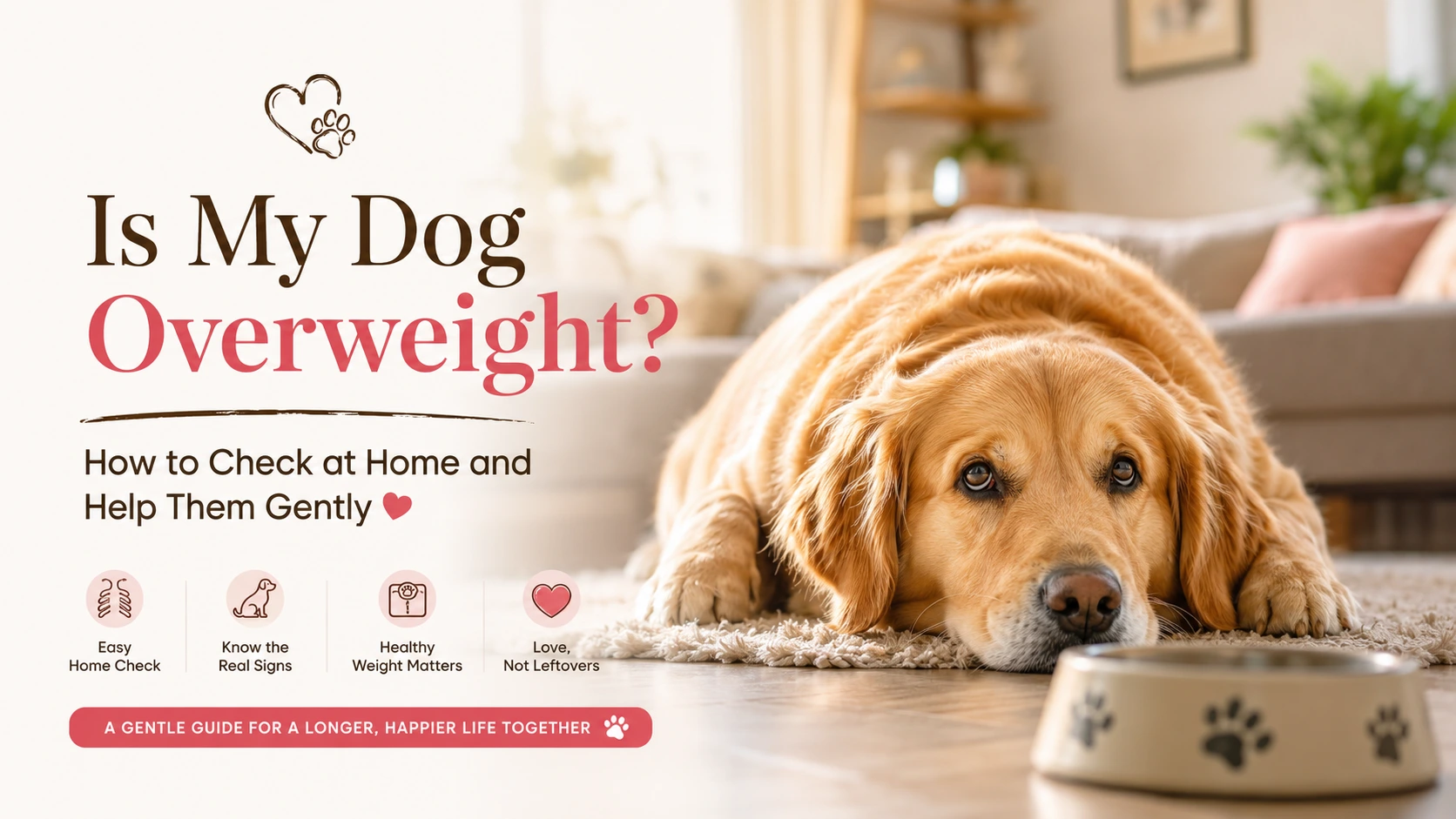
The rain of extra weight never arrives as a storm. It arrives as a biscuit here, a little leftover roti or toast crust there, a "just this once" that quietly becomes every evening.
And because we see our dogs every single day, the change is almost invisible. The waist softens. The walk gets a little slower. The jump onto the sofa needs a second try. None of it looks like a problem — it looks like love, routine, and a dog who enjoys their food.
If you've found yourself wondering, "Is my dog overweight?" — please know this first: you are not a bad dog parent for asking. You are a wonderful one. Most extra weight in dogs creeps up out of affection, not neglect. And the fact that you're checking means your dog is lucky to have you.
The short answer: Stand above your dog and look for a visible waist behind the ribs. Run your hands along their sides — you should feel the ribs easily under a thin layer of fat, without pressing hard. If you can't feel ribs, or there's no waist, your dog is likely carrying extra weight. Confirm with your veterinarian using a Body Condition Score, and never start a crash diet on your own.
Why Extra Weight Is So Easy to Miss
Here is a gentle but important truth: most of us cannot see our own dog's weight clearly.
Surveys by the Association for Pet Obesity Prevention suggest that roughly 59% of dogs in the United States are overweight or obese — yet most owners of overweight dogs believe their dog is at a perfectly acceptable weight. A study published in the Journal of Nutritional Science found that even when owners were given a visual body condition chart, 85% of owners of overweight dogs still underestimated their dog's body condition.
This isn't carelessness. It's psychology. We normalise what we see every day, the same way parents often don't notice their children growing. And because so many dogs around us carry extra weight, a slightly round dog has started to look "normal."
There's also the love problem. Food is one of the clearest ways we show affection, and our dogs have spent thousands of years perfecting the art of asking for it. Those eyes at the dinner table are not hunger — they are strategy. Very good strategy.
So if your dog has gained weight, be kind to yourself. What matters is not how it happened. What matters is what you do next — and the next part is genuinely hopeful.
How to Check Your Dog at Home: The Body Condition Score
Veterinarians don't judge a dog's weight by the number on the scale alone, because a healthy weight for a Chihuahua and a Great Dane are worlds apart. Instead, they use a Body Condition Score (BCS) — a hands-on assessment of body shape and fat cover, usually on a scale of 1 to 9, where 4 to 5 is ideal. Cornell University's Riney Canine Health Center recommends exactly this approach.
You can do a simple version at home in under two minutes. You'll need nothing but your eyes and your hands.
1. The rib check (touch)
Gently run your flat palms along your dog's rib cage, just behind the front legs.
- Ideal: You can feel each rib easily under a thin cushion of fat — like feeling the back of your hand.
- Overweight: You have to press to find the ribs — more like feeling your palm.
- Obese: You can't feel individual ribs at all, even with pressure.
2. The waist check (from above)
Stand directly over your dog and look down at their back.
- Ideal: The body narrows into a visible waist behind the ribs — an hourglass hint.
- Overweight: The sides are straight, with little or no waist.
- Obese: The body is wider at the waist than at the chest, or looks oval.
3. The tummy check (from the side)
Kneel and look at your dog's profile.
- Ideal: The belly tucks upward from the chest toward the hind legs.
- Overweight: The belly line is roughly horizontal.
- Obese: The belly sags below the chest line.
If two or more of these checks point to "overweight," it's time for a conversation with your vet — not for alarm, but for a plan. Long or thick coats can hide body shape completely, so with fluffy breeds, always trust your hands over your eyes.
Safety note: A suddenly swollen or distended belly is different from gradual weight gain and can signal serious conditions such as bloat, fluid buildup or hormonal disease. If your dog's belly has changed shape quickly — especially with restlessness, retching or heavy panting — contact a veterinarian immediately.
Why a Few Extra Pounds Matter So Much
It's tempting to see a chubby dog as simply a happy, well-fed dog. But dogs are small compared to us, and every extra pound weighs far more on their body than it would on ours. For a 10 kg dog, one extra kilogram is like an average adult gaining 6–8 kg.
The science here is unusually clear — and it comes from one of the most remarkable studies ever done on dogs.
The study that changed everything
In a landmark 14-year study (Kealy et al., 2002, known as the Purina Life Span Study), researchers followed 48 Labrador Retriever littermates for their entire lives. Half were fed a normal diet; their siblings were fed 25% less and kept lean.
The lean-fed dogs lived a median of 1.8 years longer — 13 years versus 11.2. They also developed chronic diseases such as osteoarthritis significantly later in life. Same genes, same environment, same love. The only difference was body condition.
Nearly two extra years. Two more summers. Hundreds more walks. That is what a healthy weight can be worth.
What extra weight quietly does
Veterinary bodies including AAHA (the American Animal Hospital Association) link excess body fat to a long list of problems:
- Joint disease and arthritis — extra load wears joints faster and makes existing pain worse
- Diabetes mellitus — fat tissue disrupts how the body handles sugar
- Breathing difficulty — especially in flat-faced breeds and in hot weather
- Heart and blood pressure strain
- Kidney dysfunction
- Increased risk of some cancers
- Chronic low-grade inflammation — fat is not inert padding; it is an active tissue that releases inflammatory hormones throughout the body
- A shorter life — as the Life Span Study showed so clearly
None of this is written to frighten you. It's written because the reverse is also true: helping your dog reach a healthy weight measurably reduces these risks, eases existing joint pain, and can add active, tail-wagging years to their life. Few things you can do at home have this much power.
What Actually Causes Weight Gain in Dogs
Before fixing anything, it helps to understand where the weight comes from. It's rarely one big thing — it's a quiet team of small things.
- Portions measured by eye. A "cup" of kibble poured freely is often 20–50% more than intended. Day after day, that surplus becomes weight.
- Treats that don't get counted. Training treats, dental chews, table scraps, the toast corner — they all carry calories, and in a small dog, one biscuit can be the calorie equivalent of a human eating a burger.
- Feeding guidelines on the packet. These are broad averages. Many adult dogs, especially calm indoor companions, need noticeably less than the label suggests.
- Age. Metabolism and activity naturally slow as dogs mature, but the food bowl often stays the same.
- Neutering. Spayed and neutered dogs typically need fewer calories; without an adjustment, gradual gain is common.
- Too little movement — sometimes because weight has already made exercise uncomfortable, creating a difficult cycle.
- Genetics. Some dogs really are hungrier by design. Researchers at the University of Cambridge discovered that many Labrador and flat-coated retrievers carry a mutation in the POMC gene that disrupts the brain's fullness signals — affected dogs feel hungry even when they've had enough. A 2025 study in Science, supported by the Morris Animal Foundation, identified another gene, DENND1B, linked to higher body fat in Labradors and, remarkably, to obesity in humans too.
- Medical conditions. Hypothyroidism and Cushing's disease can cause weight gain that diet alone won't fix — one more reason a vet visit comes first.
If your dog is one of the "always hungry" ones, that last part matters emotionally too: their begging is not greed or bad manners. Their brain may genuinely never feel full. They can't eat less on their own — they need you to be the gentle gatekeeper.
A Kind, Step-by-Step Weight Loss Plan
Helping a dog lose weight is not about punishment or empty bowls. Done properly, your dog can lose weight without ever feeling starved — and most of the change happens in your habits, not theirs.
Step 1: Start with your veterinarian
Before changing anything, get a professional Body Condition Score, an accurate weight, and a target. Your vet will also rule out medical causes and set a safe pace — typically 1–2% of body weight per week. Crash diets are dangerous for dogs; slow is not just safer, it's more likely to last.
Step 2: Measure every meal — with a real measure
Use a proper measuring cup or, even better, a kitchen scale. This single habit is the quiet hero of almost every successful dog weight-loss story. Weigh out the daily amount in the morning, and everything your dog eats that day — including training treats — comes from that allowance.
Step 3: Bring treats under control without losing the joy
AAHA guidance recommends that treats make up no more than 10% of daily calories. You don't have to stop treating — treat smarter:
- Break treats into pea-sized pieces; dogs care about the event, not the size
- Swap biscuits for carrot sticks, cucumber, green beans or plain steamed pumpkin
- Set aside part of the daily kibble as "treats" for training
- Replace one food-treat per day with a game, a sniff walk or tummy rubs — attention is the treat your dog actually wants
Just be sure anything you offer is dog-safe — our guide on which common foods dogs can and cannot eat covers the kitchen staples.
Step 4: Slow the eating down
Slow-feeder bowls, snuffle mats and food-puzzle toys stretch a two-minute meal into fifteen minutes of satisfying work. The dog eats the same amount but feels far more fed — especially valuable for those genetically hungry retrievers.
Step 5: Build movement gently
For an overweight dog, don't begin with long runs. Begin with:
- Two or three shorter walks rather than one exhausting one
- Sniffing time — a slow "sniffari" is genuinely tiring in the best way
- Gentle play sessions that end before your dog is worn out
- Swimming, where available — wonderful for heavy dogs because it spares the joints
Watch for excessive panting, lagging behind or reluctance, and avoid exercise in the heat of the day — overweight dogs overheat much faster.
Step 6: Track weekly, celebrate small wins
Weigh your dog every week or two (weigh yourself holding the dog, then alone, and subtract — or use the vet clinic's scale). Take a monthly photo from above. Progress in dogs is measured in grams and centimetres, and it adds up faster than you'd think. A tracking routine like the one in our complete dog care guide makes this effortless.
Remember: Every family member has to join the plan. One person's secret table scraps can undo everyone else's care. Hold a two-minute family meeting, agree the rules, and put the daily treat allowance in a visible jar — when it's empty, it's cuddles only.
Habits to Let Go Of
A few common patterns quietly work against even the most loving weight plan — several appear in our guide to common dog parent mistakes:
- Free-feeding — leaving food out all day makes portion control impossible. Scheduled meals also let you spot appetite changes early, which matters because a dog refusing food is often the first sign of illness.
- Table scraps and plate-licking rights. Human food is calorie-dense, often too fatty, and sometimes outright toxic to dogs.
- "Finishing" what another pet left.
- Guessing portions after the bag changes. Different foods have very different calorie densities — re-check amounts whenever you switch.
- Crash diets and skipped meals. Rapid weight loss can cause serious illness in dogs and almost always rebounds.
- Assuming a round dog is a healthy dog. The roundness we find adorable is the very thing shortening the years we get together.
When to See the Vet
Make an appointment — sooner rather than later — if:
- Your dog has gained noticeable weight quickly, over weeks rather than months
- The belly looks swollen or pot-bellied rather than evenly rounded
- Weight gain comes with increased thirst or urination, hair loss, lethargy or skin changes — possible signs of hormonal disease
- Your dog is eating less but still gaining
- You've followed a sensible plan for 6–8 weeks with no progress
- Your dog shows joint pain, stiffness, or struggles to rise, jump or climb stairs
- Breathing seems laboured during mild activity
And if your dog is scratching, licking or showing skin trouble alongside a diet change, food sensitivities can be involved — our guide to dog allergy symptoms and management explains what to watch for.
The Heart of It
Your dog doesn't know what a calorie is. They only know that food comes from your hands, and your hands are their favourite thing in the world.
That's exactly why this is in your power. Your dog will never read a nutrition label, step on a scale by choice, or decide to skip a biscuit. Every gram they lose will be a gift you gave them — invisible to them, immense in effect.
The Labrador study put a number on it: nearly two extra years. But numbers don't capture what those years contain. Another monsoon of muddy paw prints. Another winter of couch cuddles. More mornings of that ridiculous full-body wag when you reach for the leash.
A slightly smaller dinner, given with the same enormous love. That's the whole secret.
Frequently Asked Questions
Found this helpful? Share it with a fellow dog parent:
References & trusted sources
- Cornell Riney Canine Health Center — Obesity and weight loss in dogs
- AAHA — 2021 Nutrition and Weight Management Guidelines for Dogs and Cats
- Association for Pet Obesity Prevention — Dog Body Condition Score
- Kealy et al. 2002 — Effects of diet restriction on life span in dogs (Purina Life Span Study)
- Raffan et al. 2016 — POMC gene deletion and appetite in Labrador retrievers (Cell Metabolism)
- Morris Animal Foundation — Shared obesity gene (DENND1B) in dogs and humans, Science 2025
- Eastland-Jones et al. — Owner misperception of canine body condition (Journal of Nutritional Science)
Keep your dog's care organized
The Complete Dog Care Planner turns all of this into one calm, simple routine you can actually stick to.