
When Their Steps Slow Down: Everything You Need to Know About Dog Arthritis, Joint Health & Senior Mobility
Arthritis affects up to 80% of dogs over eight — and most owners never see it coming. This evidence-based guide covers the early warning signs, breakthrough treatments, weight management science, and simple home changes that can give your dog years of comfortable, happy life.
Written by the Raise Happy Dog editorial team. Educational only — not a substitute for your veterinarian. Read our editorial policy.
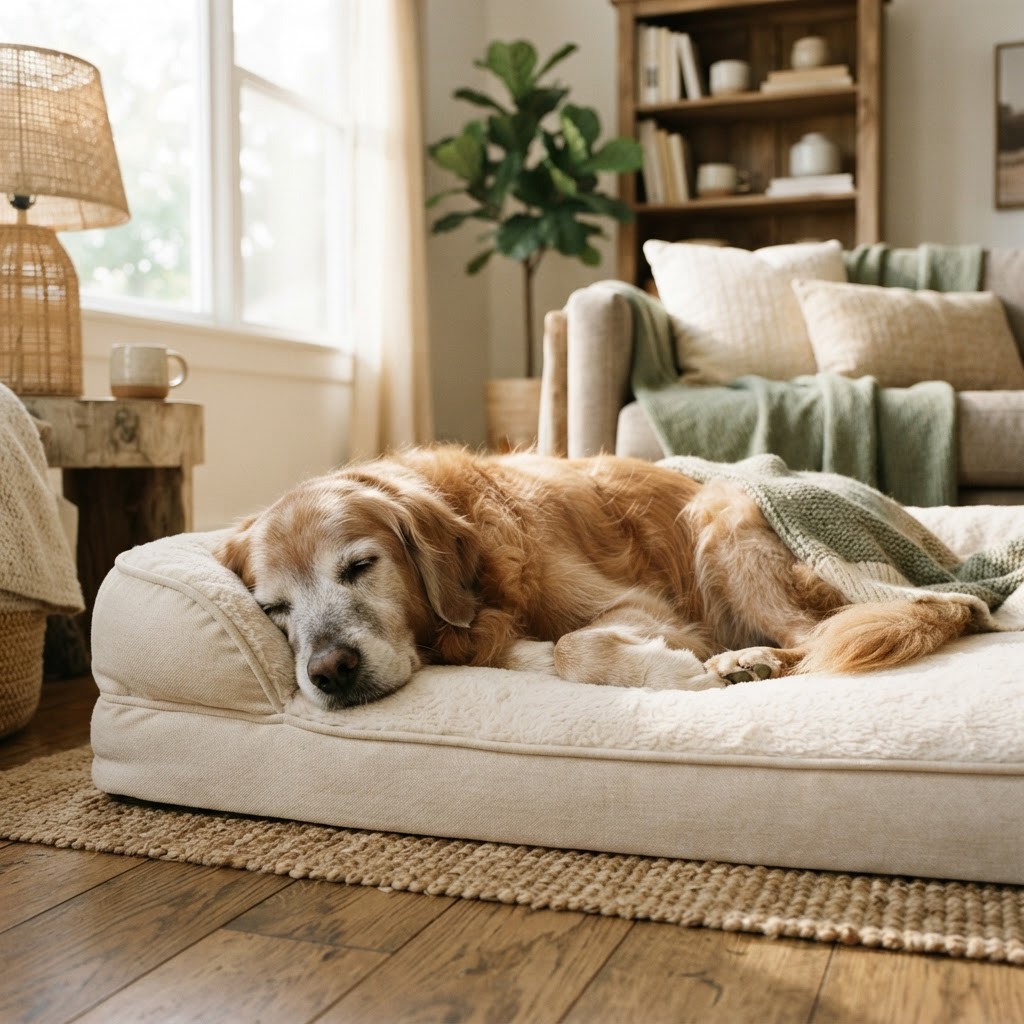
Because the dog who once raced you to the door deserves to walk through it without pain.
You remember the day clearly. The explosive zoomies across the backyard. The effortless leap onto the couch. The way your dog would hear the leash jingle from two rooms away and come skidding around the corner, tail a blur, as if the walk ahead was the greatest adventure on Earth.
And then, one morning — so quietly you almost missed it — something changed.
Maybe it was the slight hesitation before jumping into the car. Maybe it was the way they sat down a little differently, or took an extra second to stand up after a nap. Maybe they stopped chasing the ball on the third throw instead of the tenth. You told yourself: They're just tired. It's the weather. They're getting older.
You weren't wrong about the last part. But "getting older" doesn't have to mean getting slower. And that subtle shift you noticed? It has a name. It's called osteoarthritis (OA) — and it is the single most common orthopedic condition affecting dogs worldwide.
This article isn't here to scare you. It's here to empower you. Because arthritis in dogs is not a death sentence. It's not the end of walks, play, or joy. With the right knowledge and early action, you can give your dog years — literal years — of comfortable, happy, tail-wagging life.
Let's walk through this together.
How Common Is Dog Arthritis? The Numbers Will Surprise You
Here's a truth that most pet parents never hear until it's too late:
Approximately 14 million adult dogs in the United States alone are living with osteoarthritis right now.
According to research published in Frontiers in Veterinary Science and data from the Morris Animal Foundation, roughly 20–25% of the entire adult canine population is affected by OA. But that number only scratches the surface.
Look deeper, and the picture gets more sobering:
| Age Group | Estimated OA Prevalence |
|---|---|
| Dogs over 1 year old | ~20% |
| Dogs under 4 years old | ~40% show signs of joint disease |
| Dogs over 8 years old | Up to 80% |
(Sources: University of Florida College of Veterinary Medicine; Frontiers in Veterinary Science; University of Illinois College of Veterinary Medicine)
Yes, you read that correctly. 40% of dogs under four years old already show signs of joint disease. This isn't just a "senior dog" problem — arthritis can begin long before a single grey hair appears on their muzzle.
Perhaps most alarming is a 2025 study highlighted by the American Veterinary Medical Association (AVMA): when dogs undergoing routine dental procedures were given radiographs, 60% showed evidence of osteoarthritis — even though most of their owners had no idea their dogs were affected.
Your dog may be in pain right now. And they may be hiding it from you. Because that's what dogs do. They endure.
What Exactly Is Osteoarthritis? Understanding the Enemy
To fight something, you need to understand it.
A healthy joint is a marvel of biological engineering. Two bone surfaces meet, cushioned by smooth, slippery articular cartilage. The entire space is bathed in synovial fluid — nature's lubricant — allowing bones to glide against each other with almost zero friction. Surrounding muscles, tendons, and ligaments hold everything stable.
Osteoarthritis is what happens when this system breaks down.
The cartilage — that precious shock absorber — begins to thin, crack, and erode. Without its protection, bone grinds against bone. The body tries to repair the damage, but its response — inflammation, abnormal bone growth (called osteophytes), and thickening of the joint capsule — only makes things worse.
The result is a vicious cycle: pain → reduced movement → muscle loss → more joint instability → more pain.
According to the American College of Veterinary Surgeons (ACVS) and Cornell University College of Veterinary Medicine, OA is a chronic, progressive, and irreversible condition. The damage done to cartilage cannot be undone. But here's the critical takeaway:
The progression of arthritis can be dramatically slowed, and the pain can be managed — often very effectively — when caught early and treated with a comprehensive plan.
The Signs Your Dog Is Trying to Tell You Something
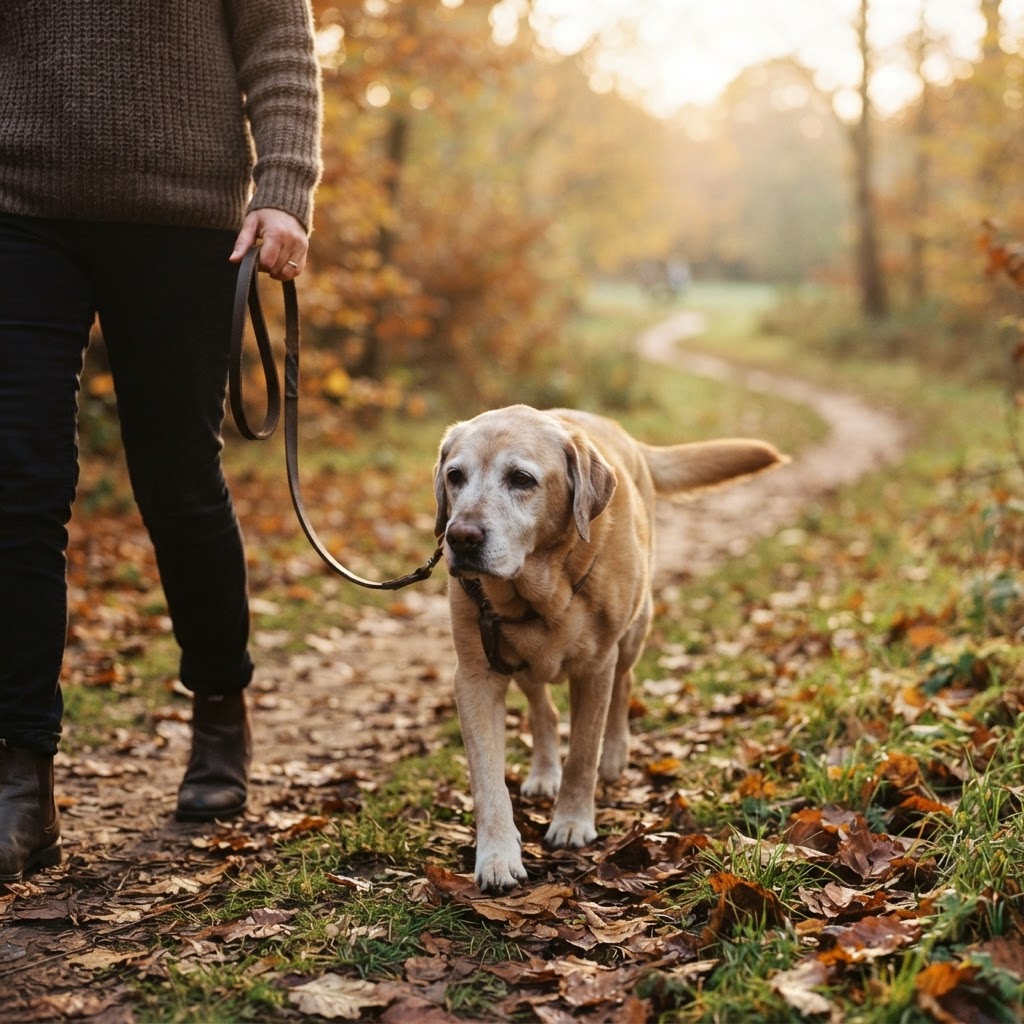
Dogs are stoic. They were shaped by evolution to mask vulnerability. A wolf that limps gets left behind. That survival instinct lives on in your Labrador, your Dachshund, your beloved mutt.
So they don't cry. They don't complain. They adapt. And by the time the signs become obvious to you, the disease may have been progressing for months — or even years.
Here's what to watch for, according to the ACVS and VCA Hospitals:
Early Warning Signs (Often Missed)
- Slower to rise after lying down or sleeping
- Hesitation before jumping onto furniture, into the car, or up stairs
- Less enthusiasm for walks or play — they seem to "give up" sooner
- Subtle stiffness especially after rest or in cold weather
- Shifting weight — they lean to one side or favor certain legs
Moderate Signs
- Visible limping or favoring a limb, particularly after exercise
- "Bunny hopping" — using both hind legs together instead of alternating
- Muscle wasting — one leg looks thinner than the other
- Licking or chewing at joints obsessively
- Sitting with legs kicked out to the side rather than tucked neatly
Advanced Signs
- Reluctance to move at all — they avoid walks, resist getting up
- Irritability — snapping when touched or handled near painful joints
- Significant muscle loss — visible thinning of the hind quarters
- Postural changes — hunched back, low head carriage
- Loss of housetraining — inability to squat or posture for elimination
If your dog shows even ONE of the early warning signs, it's time for a veterinary conversation. Early detection isn't just helpful — it is the single greatest factor in long-term outcome.
Which Dogs Are Most at Risk?
Any dog can develop arthritis — including small breeds and mixed breeds. But genetics load the gun, and weight pulls the trigger.
Breeds with Higher Predisposition
According to the Orthopedic Foundation for Animals (OFA), PetMD, and veterinary orthopedic literature, these breeds face a significantly elevated risk:
- Labrador Retrievers — the #1 most affected breed
- German Shepherd Dogs
- Golden Retrievers
- Rottweilers
- Great Danes
- Bernese Mountain Dogs
- Saint Bernards
- Newfoundlands
- Old English Sheepdogs
The common thread? Size and genetics. Large and giant breeds grow rapidly, placing enormous stress on developing joints. Many carry hereditary predispositions for hip dysplasia (prevalence ranges from 2% to over 50% depending on breed) and elbow dysplasia — developmental joint malformations that almost inevitably lead to secondary arthritis.
But breed isn't everything. The biggest modifiable risk factor is one you can control starting today.
The #1 Thing You Can Do: Weight Management (And the Study That Proved It)
If you remember only one thing from this entire article, let it be this:
Keeping your dog at a lean, healthy weight is the single most powerful thing you can do to prevent, delay, and manage arthritis.
This isn't opinion. It's one of the most well-documented facts in veterinary medicine, thanks to a landmark study that changed how the world thinks about canine health.
The Purina Life Span Study: 14 Years of Proof
Between 1987 and 2001, Purina researchers conducted a 14-year study on 48 Labrador Retrievers — one of the longest and most rigorous feeding trials ever performed on companion animals. Siblings were split into two groups: one fed freely and one fed 25% fewer calories to maintain a lean body condition.
The results were staggering:
| Outcome | Lean-Fed Dogs | Control-Fed Dogs |
|---|---|---|
| Median lifespan | 13.0 years | 11.2 years |
| Extra years of life | +1.8 years (15% longer) | — |
| Hip OA by end of life | 50% affected | 83% affected |
| Hip dysplasia by age 2 | 50% lower incidence | Higher incidence |
| Severity of OA | Significantly milder | More severe |
(Source: Purina Life Span Study, Journal of the American Veterinary Medical Association)
Let that sink in. Simply by keeping these dogs lean, they lived nearly two extra years and had dramatically less arthritis. The lean dogs didn't just live longer — they lived better. They moved more freely. They had more good days.
How to Assess Your Dog's Weight
Veterinarians use the Purina Body Condition Score (BCS) — a 1 to 9 scale:
- Ideal (4–5): Ribs easily felt with slight fat covering. Visible waist from above. Abdominal tuck from the side.
- Overweight (6–7): Ribs hard to feel. Waist barely visible. Little or no tuck.
- Obese (8–9): Ribs buried under fat. No waist. Abdominal distension. Fat deposits on neck and limbs.
If your dog scores above a 5, talk to your veterinarian about a calorie reduction plan. Even a modest weight loss of 6–8% of body weight has been shown to produce meaningful improvements in mobility for arthritic dogs.
The Gold Standard: Multimodal Arthritis Management
Here's the truth that the best veterinarians will tell you: there is no magic pill for arthritis. No single treatment cures it. No supplement erases it.
But a multimodal approach — combining multiple strategies simultaneously — is the gold standard of care, endorsed by the AVMA, the ACVS, and the American Animal Hospital Association (AAHA).
Think of it like building a wall. Each brick alone is insufficient. Together, they form something strong.
1. Pain Management: NSAIDs
Non-steroidal anti-inflammatory drugs (NSAIDs) remain the cornerstone of arthritis pain management. Medications like meloxicam, carprofen, and deracoxib reduce inflammation and pain at the source.
Important: Canine NSAIDs are not the same as human NSAIDs. Never give your dog ibuprofen, aspirin, or naproxen — they can cause fatal kidney or gastrointestinal damage. Always use veterinarian-prescribed medications with appropriate blood work monitoring.
2. The Breakthrough: Librela (Bedinvetmab) — A New Era in Pain Relief
One of the most significant advances in veterinary pain management in decades, Librela is an FDA-approved monoclonal antibody specifically designed for canine osteoarthritis pain.
How it works: Librela targets and neutralizes nerve growth factor (NGF) — a protein that amplifies pain signals. By blocking NGF, pain signals are prevented from reaching the brain, providing relief without the gastrointestinal side effects commonly associated with NSAIDs.
What the evidence shows:
- In pivotal clinical trials, dogs receiving monthly Librela injections showed significant improvements in pain severity and mobility compared to placebo (FDA approval data)
- Comparative studies found Librela provided equivalent efficacy to meloxicam (a widely used NSAID) (Frontiers in Veterinary Science)
- Real-world clinical experience reports high levels of veterinarian and owner satisfaction
Important safety note: While Librela is generally well-tolerated, the veterinary community is monitoring rare but serious potential risks, including musculoskeletal changes and rapidly progressive osteoarthritis (RPOA) in some cases. Because NGF plays a role in joint health maintenance, ongoing monitoring is essential. Always discuss your individual dog's medical history with your veterinarian before starting Librela.
3. Omega-3 Fatty Acids: The Evidence-Backed Supplement
If there's one supplement with genuine, consistent scientific support for joint health, it's omega-3 fatty acids — specifically EPA and DHA.
What the research says:
- Systematic reviews and meta-analyses confirm clear clinical analgesic efficacy for omega-3 supplementation in dogs with OA (NIH/PubMed indexed studies)
- A 2024 study found daily marine omega-3 supplementation (~68–70 mg EPA+DHA per kg body weight) significantly improved pain scores and quality of life (NIH/PubMed)
- Omega-3s work by modulating inflammatory pathways, reducing pro-inflammatory mediators that drive joint pain and cartilage destruction
Best sources:
- Fish oil: The tried-and-tested standard. Look for high-concentration EPA/DHA formulations.
- Green-lipped mussel (GLM): Contains EPA, DHA, plus a unique fatty acid called ETA and natural glycosaminoglycans. Some research suggests GLM targets inflammatory pathways more specifically at lower doses.
Pro tip: Look for products carrying the National Animal Supplement Council (NASC) quality seal. The supplement market is unregulated — quality, concentration, and bioavailability vary wildly between brands. (Cornell University College of Veterinary Medicine)
4. Glucosamine & Chondroitin: An Honest Assessment
These supplements are everywhere — in treats, chews, powders, and tablets marketed as "joint support." But what does the science actually say?
The honest answer: it's mixed.
- Some clinical studies have found no significant improvement over placebo (AVMA; published clinical trials)
- Other research and clinical observations suggest potential benefits as part of a broader management plan
- Absorption (bioavailability) in dogs may be limited
- They are not a substitute for medical pain management
Bottom line: Glucosamine and chondroitin may provide modest support for some dogs, but they should never be the only intervention. If you choose to use them, do so as one piece of a multimodal plan — not as a standalone cure. And always choose NASC-certified products.
5. Physical Rehabilitation & Hydrotherapy: Moving Through the Pain
This might sound counterintuitive — how can movement help a dog in pain? — but structured, controlled exercise is one of the most powerful tools in arthritis management.
Why it works:
- Maintains muscle mass — strong muscles stabilize and protect joints
- Preserves range of motion — movement prevents joints from stiffening further
- Controls weight — activity burns calories without the risks of over-exertion
- Releases endorphins — natural pain-relieving chemicals
Hydrotherapy and underwater treadmill (UWTM) therapy are particularly effective because water's buoyancy reduces the load on joints by up to 60%, allowing dogs to move and build strength with minimal pain. (Purdue University; Frontiers in Veterinary Science)
Modern veterinary rehabilitation centers use integrated monitoring systems to track gait symmetry, ground reaction forces, and joint range of motion — allowing for precise, individualized treatment protocols.
Key guideline: Always work with a certified veterinary rehabilitation specialist. Unsupervised or inappropriate exercise can worsen joint damage. Swimming is excellent for cardiovascular fitness, but the underwater treadmill is generally preferred for targeting hind-leg strength and gait retraining. (Canine Arthritis Management; Purdue University)
Making Home a Sanctuary: Environmental Modifications That Matter

Medicine manages the disease. But your home manages your dog's daily experience. And small changes can transform their quality of life.
Flooring & Traction
Slippery hardwood and tile floors are an arthritic dog's enemy. Every slip causes pain, fear, and potential injury.
- Lay non-slip rugs and runners along high-traffic paths (bed → food → door)
- Use non-slip rug pads underneath to prevent rugs from bunching
- Keep nails trimmed short for better paw grip
- Consider rubber-grip paw socks or paw wax for extra traction
Bedding
Your dog's bed is no longer a luxury — it's medical equipment.
- Choose a true orthopedic bed with at least 3–4 inches of high-density memory foam
- Look for a low entry point so they can step in without lifting painful legs over a bolster
- Use a waterproof liner and machine-washable cover
- Place beds in warm, draft-free areas — cold worsens joint stiffness
Access & Mobility
Every jump is a micro-trauma to arthritic joints.
- Install ramps (not stairs) for getting onto furniture, into cars, and up steps — ramps provide a gradual incline with less joint strain
- Ensure all ramps are sturdy, wide, and non-slip
- Consider a rear-support or full-body lift harness for dogs who need help standing or navigating obstacles
- Raise food and water bowls to elbow height to prevent painful neck and shoulder strain while eating
Climate & Comfort
- Keep your home warm — arthritic joints are noticeably worse in cold weather
- Provide heated pet pads or blankets in resting areas during winter
- Ensure walking paths are well-lit, especially if your senior dog also has age-related vision changes
Exercise: The Art of Doing Enough (But Not Too Much)
One of the cruelest aspects of arthritis is this: your dog still wants to do everything they used to. Their heart says "GO!" even when their joints say "STOP."
It's your job to be the gentle governor.
The Rules of Smart Exercise for Arthritic Dogs
- Shorter, more frequent walks — Two 15-minute walks are better than one 30-minute walk
- Consistent pace — No sudden sprinting, leaping, or rough play
- Warm up and cool down — Start slow, let joints loosen, and wind down gently
- Soft surfaces when possible — Grass and trails are kinder than concrete
- Watch the "next-day test" — If your dog is stiffer the morning after exercise, you did too much. Scale back.
- Never stop moving entirely — Inactivity leads to muscle loss, weight gain, and faster joint deterioration. Movement is medicine — in the right dose.
The Emotional Weight: What No One Talks About
Let's pause from the clinical facts for a moment and talk about something real.
Watching your dog slow down is one of the most quietly devastating experiences in pet parenthood. There's no dramatic event. No emergency. Just a gradual, steady dimming of the light that once burned so bright.
You see them struggle to stand, and you feel it in your chest. You watch them stare at the couch they can no longer jump onto, and something inside you breaks a little. You adjust their walk route — shorter now, always shorter — and you try not to think about what comes next.
This grief is valid. It's called anticipatory grief, and it's as real as any loss. You're mourning the version of your dog that was — while still loving the dog that is.
But here's what I want you to hold onto:
Your dog is not counting the walks they can no longer take. They're feeling the warmth of the one they just had — with you.
They don't measure joy in miles. They measure it in presence. In the sound of your voice. In the hand that rests on their head while they rest on their bed. In the fact that you showed up, again, today.
The goal of arthritis management isn't to make your dog young again. It's to make every remaining day as comfortable, as dignified, and as full of love as possible. That's not settling. That's the deepest act of devotion.
A Quick-Reference Action Plan
| Priority | Action | Why It Matters |
|---|---|---|
| 🔴 Critical | Maintain lean body weight (BCS 4–5) | Reduces joint stress; can extend life by 1.8 years |
| 🔴 Critical | Veterinary diagnosis & pain plan | Early intervention dramatically improves outcomes |
| 🟠 High | Omega-3 fatty acids (EPA/DHA) | Clinically proven anti-inflammatory and pain-reducing effects |
| 🟠 High | Environmental modifications (ramps, rugs, orthopedic bed) | Prevents injury; improves daily comfort |
| 🟡 Important | Controlled, consistent exercise | Maintains muscle, range of motion, and mental health |
| 🟡 Important | Physical rehabilitation / hydrotherapy | Builds strength with minimal joint stress |
| 🟢 Supportive | Glucosamine/chondroitin (NASC-certified) | May provide modest benefit as part of multimodal plan |
| 🟢 Supportive | Warmth and climate control | Reduces cold-weather stiffness and discomfort |
When to Talk to Your Vet: The Conversation Starters
Don't wait for a limp. Here are reasons to bring up joint health at your next visit:
- Your dog is over 7 years old (or over 5 for large/giant breeds)
- You've noticed any of the early warning signs listed above
- Your dog is a high-risk breed for hip or elbow dysplasia
- Your dog is overweight (BCS above 5)
- Your dog has a history of joint injury, cruciate ligament tear, or surgery
- You want to start preventive joint support before symptoms appear
Ask your vet about:
- An OA screening assessment or joint health checklist
- Whether your dog is a candidate for Librela
- An appropriate omega-3 dosage for their weight
- A referral to a veterinary rehabilitation specialist
- A weight management plan with specific calorie targets
The Promise We Make
When you brought your dog home — whether as a bouncing puppy or a quiet rescue with old eyes — you made a promise. Maybe not in words. Maybe just in the way you held them, or in the way your heart said I've got you.
Arthritis doesn't break that promise. It deepens it.
Because loving a dog through their golden years — through the stiff mornings and the slower walks and the careful lifts onto the bed — is love in its purest, most unselfish form. It's not the love of convenience. It's the love of commitment.
Your dog gave you their best years without hesitation. Every wagging tail. Every joyful greeting. Every silent comfort on your worst days.
Now it's your turn.
And if you take even one thing from this article — schedule that vet appointment, swap the bed, add the fish oil, cut back the treats, lay down that rug — you will have changed the trajectory of your dog's remaining years.
Not with grand gestures. With small, steady, loving ones.
Because that's what they've been doing for you all along.
Sources & References
This article draws from the following peer-reviewed research and authoritative veterinary institutions:
- American Veterinary Medical Association (AVMA) — OA guidelines, Librela safety monitoring, supplement evidence reviews
- American College of Veterinary Surgeons (ACVS) — Clinical signs, diagnosis, and surgical management of OA
- Morris Animal Foundation — Canine OA prevalence and research funding data
- Cornell University College of Veterinary Medicine — OA diagnosis, supplement quality and regulation
- VCA Hospitals — Clinical signs, multimodal management, glucosamine/chondroitin assessment
- Purina Life Span Study — 14-year Labrador Retriever caloric restriction trial (JAVMA published)
- MSD Veterinary Manual (Merck) — OA pathophysiology, medical and surgical treatment
- Frontiers in Veterinary Science — OA prevalence studies, Librela vs. NSAID comparisons, omega-3 meta-analyses
- U.S. Food & Drug Administration (FDA) — Librela (bedinvetmab) approval and efficacy data
- University of Florida & University of Illinois Colleges of Veterinary Medicine — Age-related OA prevalence data
- Orthopedic Foundation for Animals (OFA) — Breed-specific hip and elbow dysplasia screening data
- Purdue University College of Veterinary Medicine — Hydrotherapy and underwater treadmill evidence
- American Animal Hospital Association (AAHA) — OA management guidelines and early detection checklists
- National Animal Supplement Council (NASC) — Supplement quality certification standards
- NIH/PubMed-indexed clinical trials — Omega-3 efficacy (2024), glucosamine bioavailability, hydrotherapy ROM studies
- Canine Arthritis Management (CAM) — Owner education and environmental modification resources
- Royal Veterinary College (RVC), UK — Breed and body condition risk factor analysis
This article is for educational purposes only and does not replace professional veterinary advice. If you suspect your dog has arthritis or joint pain, please consult a licensed veterinarian for a proper diagnosis and individualized treatment plan.
Found this helpful? Share it with a fellow dog parent:
Keep your dog's care organized
The Complete Dog Care Planner turns all of this into one calm, simple routine you can actually stick to.