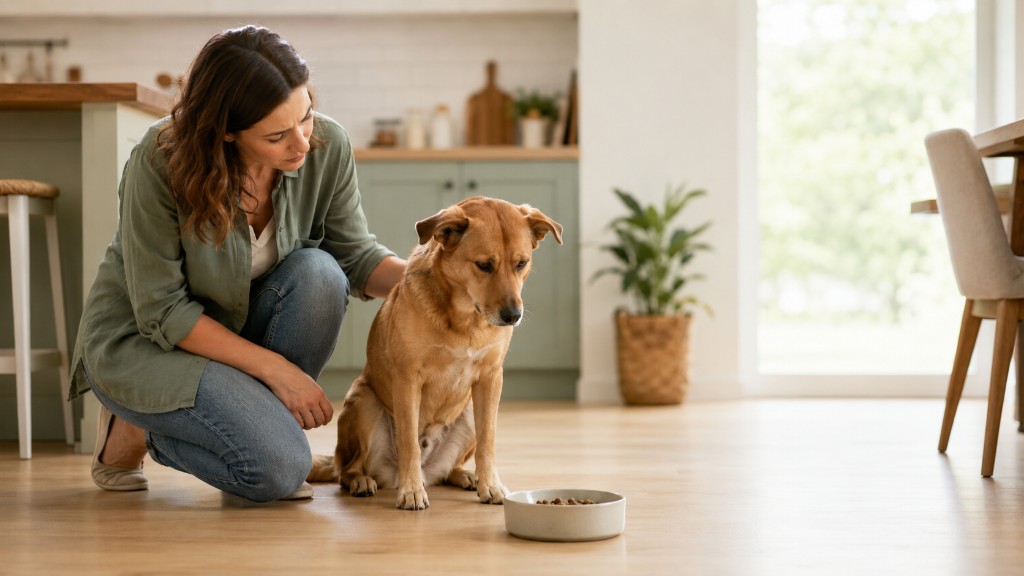
The 5-Minute Daily Dog Health Check: A Small Ritual That Can Reveal Important Changes
Five calm minutes can help you notice what is normal for your dog—and recognise meaningful changes early. Here is a gentle, practical head-to-tail routine every dog parent can use.
Written by the Raise Happy Dog editorial team and researched from 4 veterinary and scientific sources listed at the end. Educational only — not a substitute for your veterinarian. Read our editorial policy.

You do not need a stethoscope to become a better observer of your dog. You need a quiet moment, gentle hands and a clear idea of what “normal” looks like for the dog you love.
Your dog cannot tell you that one eye feels sore, getting up has become uncomfortable or drinking water has quietly become the most important part of the day. Dogs communicate in smaller ways: a pause before climbing the stairs, a bowl left unfinished, a new smell from an ear, a change in the rhythm of sleep.
These signs do not always mean illness. But changes—especially new, persistent or worsening ones—are valuable information.
That is the purpose of this five-minute daily dog health check. It is not a home examination, a diagnostic test or a replacement for preventive veterinary care. It is a gentle ritual that helps you learn your dog’s baseline and notice when something is different.
The American Animal Hospital Association’s canine life-stage guidance emphasises individualized preventive care based on a dog’s age, size, lifestyle, health and breed. Your veterinarian builds the medical plan. At home, you contribute something no clinic can reproduce: knowledge of how your dog looks and behaves on an ordinary day.
First, understand what this ritual can—and cannot—do
A daily check can help you notice:
- changes in appetite, thirst, urination or stool
- unusual discharge, redness, swelling or odour
- a new lump, sore or tender area
- stiffness, limping or reluctance to move
- a change in resting breathing
- withdrawal, restlessness or a shift in normal behaviour
It cannot tell you why a change has happened. The same sign can have many causes, and a dog who looks well can still have a medical problem. Never use this checklist to delay veterinary care, stop prescribed medicine or treat your dog with human medication.
Think of the ritual as a way to produce a better sentence for your veterinarian. Instead of “Something seems off,” you may be able to say, “Since yesterday evening, she has left half of two meals, asked to go outside four extra times and seems uncomfortable when rising.” That detail matters.
Before you begin: make it feel like care, not inspection
Choose a familiar time when your dog is awake but settled—perhaps after the morning walk or before bed. Keep the first few checks very short. Pair calm cooperation with praise, affection or a small treat if treats are appropriate for your dog.
Watch your dog’s body language. Turning away, lip licking, yawning, freezing, showing the whites of the eyes, tucking the tail, growling or trying to leave may mean they are uncomfortable. Stop rather than restrain or punish them. Pain can also make a normally tolerant dog protect an area or bite unexpectedly.
If your dog dislikes having a body part handled, simply observe it and discuss safe handling with your veterinarian or a qualified reward-based trainer. A useful health ritual should strengthen trust, not test it.
Step 1: Pause and observe before you touch
Spend the first minute doing nothing except watching.
Is your dog interested in the usual things? Do they greet you, follow household activity and settle in their familiar way? Notice posture, alertness and comfort. A dog who repeatedly changes position, cannot settle, hides, pants without an obvious reason or seems unusually distant may be communicating discomfort.
Watch the breathing
Observe breathing when your dog is truly resting—not immediately after exercise, excitement, heat exposure or stress. Cornell University’s Riney Canine Health Center describes 12–30 breaths per minute as a normal respiratory rate for dogs, while noting that breathing changes with activity and temperature.
One rise and fall of the chest counts as one breath. If you want a number, count for 30 seconds and multiply by two. More important than a single reading is a repeated change from your dog’s normal pattern.
Breathing should look easy. The abdomen should not be working hard, and your dog should not need to stretch the head and neck to draw air.
Emergency warning: Rapid or difficult breathing, open-mouth breathing that is not explained by heat or exercise, strong abdominal effort, blue-tinged gums or muzzle, weakness or collapse can signal respiratory distress. Cornell advises going quickly and calmly to the nearest emergency animal hospital and calling ahead when possible.
Step 2: Look at the eyes, ears and nose
Move slowly and use good natural light.
Eyes
Both eyes should look comfortable and generally similar to each other. Notice:
- new redness or swelling
- squinting, keeping one eye closed or rubbing the face
- yellow, green, bloody or suddenly increased discharge
- a new cloudy appearance
- pupils that look noticeably unequal
- bumping into objects or seeming unable to see normally
Eye problems can become painful and may worsen quickly. Merck Veterinary Manual includes cloudy eyes, squinting and inability to see among signs that warrant veterinary attention within 24 hours. A painful eye, sudden vision change, injury or chemical exposure deserves more urgent advice.
Ears
Look only as far as you can see without pulling or probing. Compare one ear with the other. Watch for:
- redness, swelling or heat
- a strong or unfamiliar odour
- dark, yellow or bloody discharge
- repeated scratching or head shaking
- pain when the area is approached
- a head tilt or loss of balance
Do not insert cotton buds, fingers or tools into the ear canal. Do not use leftover ear drops; a veterinarian may need to confirm that the eardrum is intact and identify the cause before choosing treatment.
Nose
A dog’s nose may be wet or dry at different times, so nose moisture alone is not a reliable health test. Pay more attention to a new sore, swelling, bleeding, thick discharge or persistent discharge from one nostril.
Step 3: Check the mouth and gums—only if your dog is comfortable
Gently lift the lip; there is no need to force the mouth open.
Look for:
- a broken, loose or heavily coated tooth
- red, swollen or bleeding gums
- a sore, mass or foreign material you can see
- new excessive drooling
- difficulty picking up, chewing or swallowing food
- breath that has changed sharply or become unusually foul
Healthy gum colour varies. Many dogs have naturally dark or mottled pigment, so learn what is normal for your dog rather than expecting every gum to be bubble-gum pink. Check a naturally unpigmented area if one is easily visible, but do not rely on colour alone.
Do not wait: Blue, grey or very white gums or tongue—especially with breathing difficulty, weakness, collapse, severe bleeding or extreme lethargy—require immediate veterinary care. Yellowing of the gums or whites of the eyes also warrants prompt veterinary advice.
Never place your hand inside the mouth of a distressed, choking or painful dog. Do not pull on string or thread disappearing into the mouth; it may extend into the digestive tract and pulling can cause injury.
Step 4: Let your hands travel over the coat, skin and body
Turn a cuddle into a consistent, gentle scan. Use the flat of your fingers and follow the same route each day: under the jaw, down the neck, over both shoulders, along the back and sides, under the chest and belly if welcomed, then down each leg and around the paws.
You are not trying to decide whether something is dangerous. You are looking for change:
- a new lump or an existing lump that has changed
- heat, swelling or tenderness
- a scab, wound, moist patch or rash
- hair loss, dandruff or a change in coat quality
- fleas, ticks or flea dirt
- persistent licking, chewing or scratching
- swelling between the toes, a damaged nail or a sore paw pad
If you find a lump, do not squeeze it. Note its location, take a clear photograph beside a ruler or coin for scale, and arrange veterinary advice. Size and feel alone cannot reliably identify a lump; veterinarians may recommend sampling it.
Check under collars and harnesses for rubbing, trapped moisture or a fit that has become too tight. In long-coated dogs, part the hair so you can see the skin.
Safety note: A rapidly enlarging swelling, a swollen face with breathing trouble, uncontrolled bleeding, a deep wound, severe pain or a bloated abdomen with repeated unsuccessful attempts to vomit needs urgent or emergency veterinary care.
Step 5: Watch movement—and review what went into and came out of your dog
The final minute connects what you see now with the rest of the day.
Movement and comfort
Watch your dog rise from a bed, walk away, turn and sit or lie down. If stairs are already part of the normal routine, notice whether the rhythm has changed; do not make a sore dog perform extra tests.
Look for:
- stiffness after rest
- limping or shortened steps
- hesitation before jumping, climbing or entering the car
- slipping, scuffing nails or dragging a paw
- an arched back or lowered head
- reluctance to be touched or picked up
- pacing, trembling or difficulty getting comfortable
Pain does not always look dramatic. Eating less, withdrawing, restlessness and changes in mood or personality can also accompany pain. Record a short video of unusual movement when it is safe to do so; dogs may move differently at the clinic, and the video can help your veterinary team.
Sudden inability to stand, staggering, collapse, severe or constant pain, or sudden severe lameness needs immediate veterinary attention. A mild limp that persists also deserves a veterinary call—rest is not a diagnosis.
Appetite and water
Notice whether your dog ate with normal interest and finished a familiar amount. Watch for dropping food, chewing on one side, approaching the bowl then turning away, vomiting or repeated swallowing.
Do not judge thirst by how often you happen to see your dog drink. If you are concerned, fill the bowl in a consistent way and observe how much remains, accounting for other pets and spills. A persistent increase or decrease in drinking can matter. Never restrict water unless a veterinarian has specifically instructed you to do so.
Urine and stool
Notice frequency, effort and obvious changes rather than trying to interpret every variation.
Call your veterinarian about repeated diarrhoea or vomiting, blood, black tar-like stool, new accidents, marked changes in frequency, pain, or persistent straining. Straining without producing urine is an emergency, particularly in a dog repeatedly trying to urinate.
The most useful tool is a simple baseline
“Normal” is personal. A young sighthound, an older Labrador and a flat-faced dog may look and behave differently even when healthy. Build your baseline on ordinary days.
Once a week, write down a few short observations:
- appetite: usual / changed
- water intake: usual / changed
- urine and stool: usual / changed
- energy and behaviour: usual / changed
- movement: usual / changed
- skin or lumps: none / unchanged / new change
- resting breathing: usual, or a counted rate if your vet has asked you to track it
Use dates, photos and videos. Avoid vague labels such as “bad.” Record what you actually saw: how often, how long, when it began and whether it is getting better or worse.
When should you call the vet?
Seek emergency veterinary care now
Contact an emergency veterinary service immediately for signs such as:
- difficulty breathing, blue or white gums, or collapse
- choking, seizures or heavy uncontrolled bleeding
- inability to stand, staggering or sudden severe weakness
- severe or constant pain
- repeated straining without producing urine
- a swollen abdomen with repeated unproductive retching
- suspected poisoning, heatstroke or serious trauma
This is not a complete emergency list. If your dog looks seriously unwell or you are uncertain, call a veterinary professional rather than waiting for the next daily check.
Arrange prompt veterinary advice
Contact your regular veterinarian for new, persistent or worsening changes, including:
- a sudden change in behaviour or energy
- loss of appetite or a marked change in drinking
- repeated vomiting or diarrhoea
- coughing, persistent sneezing or unusual breathing at rest
- eye discomfort, cloudiness or discharge
- ear discharge, odour, pain or repeated head shaking
- a new or changing lump
- persistent itching, licking or hair loss
- limping, stiffness or reluctance to move
- changes in urination, stool or house-training
Merck Veterinary Manual advises immediate care for several severe signs and veterinary attention within 24 hours for others such as sudden behaviour change, cloudy or squinting eyes, abnormal lumps, persistent lameness and discharge. Your dog’s age, medical history and combination of signs can change the urgency, so call when in doubt.
What not to do
A careful observer also knows where observation should stop.
- Do not give ibuprofen, paracetamol/acetaminophen, aspirin or other human medicine unless your veterinarian has prescribed a specific product and dose for your dog.
- Do not diagnose a lump by its appearance or search result.
- Do not clean a painful ear or eye before asking for advice if an injury or severe problem is possible.
- Do not force handling when your dog is afraid or painful.
- Do not wait for a symptom to become dramatic if your instincts and your records tell you there has been a meaningful change.
Frequently asked questions
Should I perform a daily dog health check on a puppy?
Yes, but keep it playful and very brief. Gentle, reward-based handling can help a puppy become comfortable with having paws, ears and lips observed. Puppies can also become unwell quickly, so contact your veterinarian promptly about vomiting, diarrhoea, poor appetite, lethargy or anything that concerns you.
Is a dry nose a sign that my dog is sick?
Not by itself. Nose moisture changes with sleep, weather, licking and activity. A dry nose without other changes is usually less informative than your dog’s appetite, behaviour, breathing and comfort. Persistent cracking, sores, bleeding or unusual discharge should be discussed with your veterinarian.
How often should I check my dog for lumps?
A light daily stroke makes changes easier to notice, while a more deliberate head-to-tail skin check once a week is practical for many families. Any new or changing lump should be assessed by a veterinarian; touch alone cannot tell you what it is.
Does this routine replace an annual veterinary check-up?
No. Veterinary examinations, vaccinations, parasite prevention, dental care and screening plans should be tailored to your dog’s life stage and health risks. The home check adds everyday observations to that professional care—it does not replace it.
Five minutes that say, “I am paying attention”
Most days, this ritual will reveal nothing surprising. That is not wasted time. You are learning the ordinary map of your dog: the freckles on the gums, the small old scar near a paw, the easy rhythm of a sleeping chest, the familiar way they rise and stretch.
Then, if the map changes, you are more likely to notice.
The gift is not constant worry. It is calm familiarity. Five minutes, gentle hands and the quiet promise every dog deserves: I know your normal, and I will pay attention when you need me.
Found this helpful? Share it with a fellow dog parent:
References & trusted sources
Keep your dog's care organized
The Complete Dog Care Planner turns all of this into one calm, simple routine you can actually stick to.