
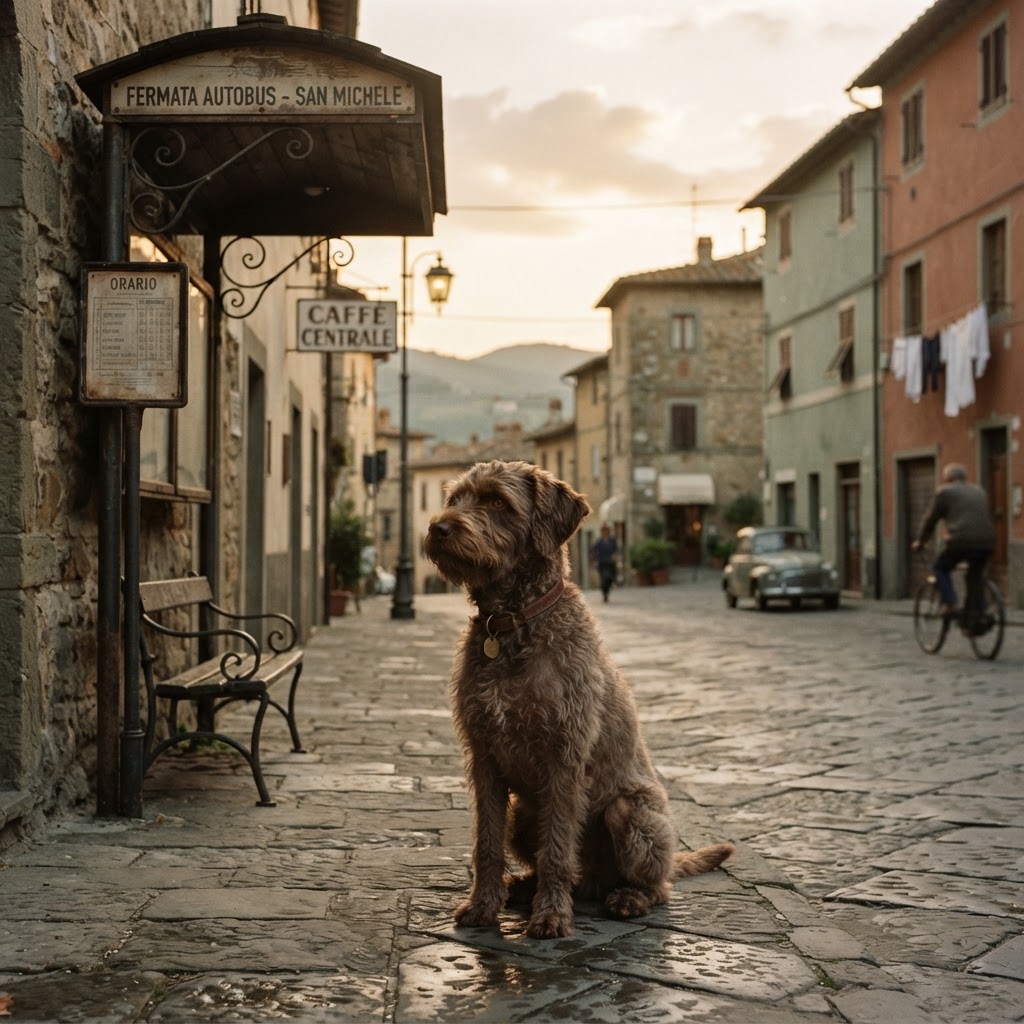
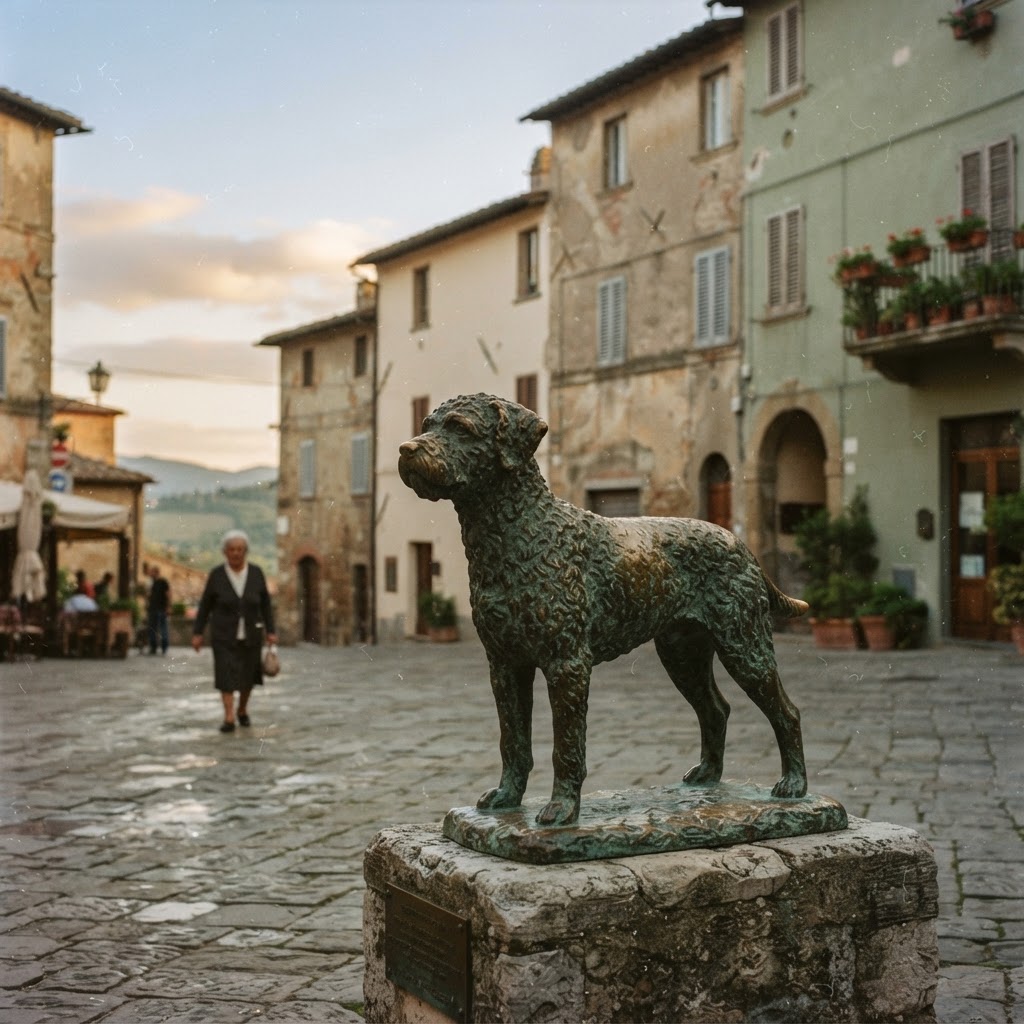
There is a small town in Italy, nestled among the green hills of Tuscany, where the streets are narrow and the church bells still ring at dusk. It is called Borgo San Lorenzo. And if you ever visit, you will find, standing quietly in its central square, a bronze statue of a dog — ears slightly raised, eyes looking into the distance, as though he is still waiting for someone.
His name was Fido.
And his story, once you hear it, you will never forget.
A Broken Body, A Kind Hand
It was November of 1941. The world was at war. Europe was burning. And on a cold, rain-soaked roadside ditch near Borgo San Lorenzo, a small puppy lay shivering — injured, abandoned, barely alive.
He had no name. He had no home. He had no one.
Until a man stopped.
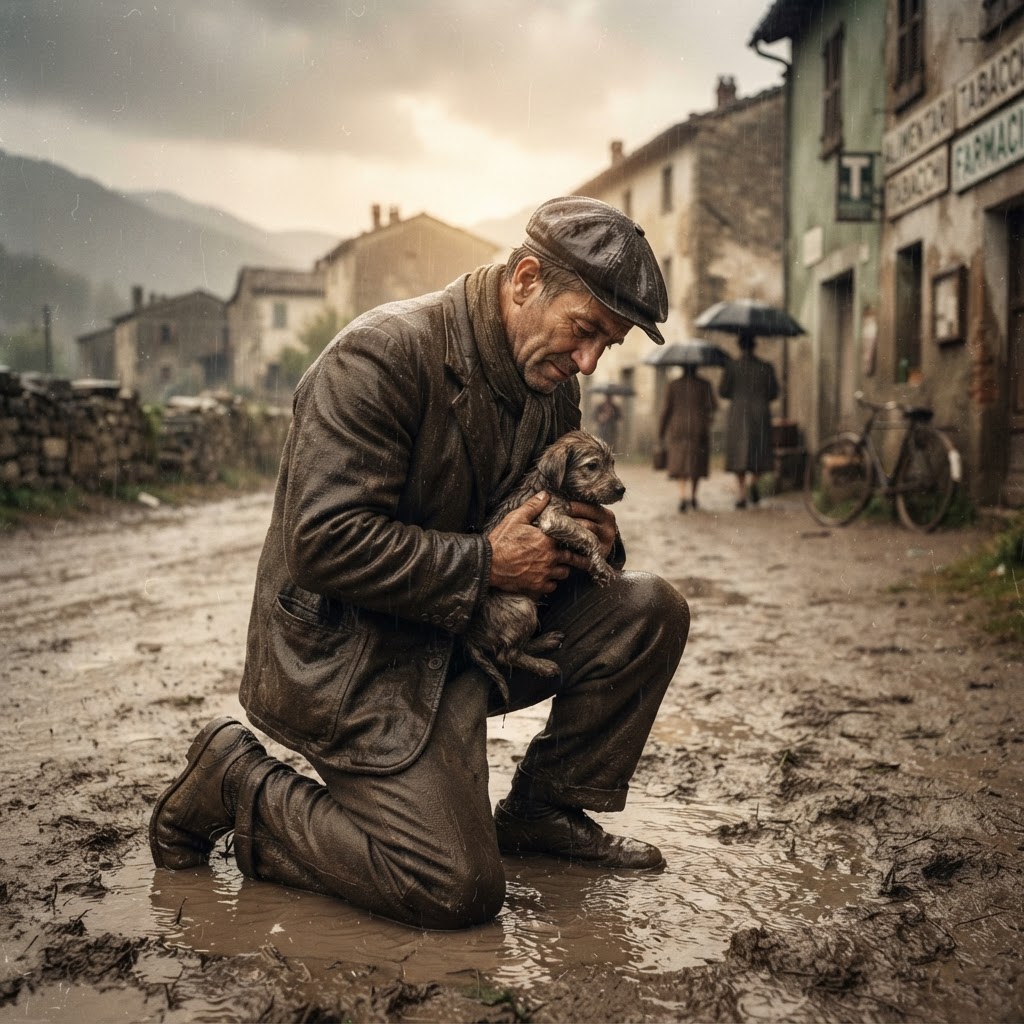
His name was Carlo Soriani — a simple factory worker at a brick kiln, a man who earned modest wages and lived a humble life. Carlo was returning home from a long day's work when he noticed the trembling shape in the mud. Most people would have walked past. The world was full of suffering — what was one more stray puppy?
But Carlo was not most people.
He knelt down. He picked up the injured puppy, cradled him against his chest, and carried him home. He cleaned his wounds. He fed him warm food. He gave him a blanket by the fire.
And he gave him a name — Fido, from the Latin word fidus, meaning faithful.
Carlo did not know it then, but he had just named a prophecy.
The Ritual of Love
As the weeks passed, Fido healed — not just in body, but in spirit. Under Carlo's patient care, the once-broken puppy became a lively, devoted companion. The two formed a bond so quiet and so deep that words were unnecessary between them.
Every morning, without fail, Fido would walk beside Carlo to the bus stop in the town square. He would sit there, watching his master board the bus to the factory. And every evening, at exactly the time the bus returned, Fido would be there again — sitting in the same spot, tail wagging, eyes bright, waiting for the one face in the crowd that was the centre of his entire universe.
The bus doors would open. Carlo would step off. And Fido would leap up with a joy so pure, so uncontainable, that it made the other passengers smile.
Then the two of them would walk home together — man and dog, side by side, through the golden light of the Tuscan evening.
This was their ritual. Their sacred, wordless promise to each other.
It continued, day after beautiful day, for two years.
“This was their ritual. Their sacred, wordless promise to each other.”
The Day the Bus Came Home Empty
On December 30, 1943, the war finally reached Borgo San Lorenzo.
Allied bombers struck the industrial area where Carlo's factory stood. The building was destroyed. And Carlo Soriani — the quiet, kind-hearted man who had once knelt in the rain to save a broken puppy — was killed.
He was among dozens who perished that day.
That evening, as the winter sky darkened and the cold crept through the streets, Fido walked to the bus stop — just as he had done every evening for two years.
He sat down.
He waited.
The bus arrived. The doors opened. People stepped off.
But Carlo was not among them.
Fido watched every face. He waited until the last passenger had gone. He waited until the square was empty and the streetlights flickered on and the silence settled over the cobblestones like snow.
Then, slowly, he turned and walked home — alone.
Fourteen Years of Faith
But here is where this story breaks your heart wide open.
The next evening, Fido returned to the bus stop. And the evening after that. And the one after that.
He came back every single day for fourteen years.
Through rain and sun, through summer heat and winter frost, through the end of the war and the rebuilding of the town and the passing of the seasons — Fido walked to the bus stop, sat down, and waited for the man who would never come home again.
More than five thousand evenings. Five thousand times he watched the bus doors open. Five thousand times he searched for that familiar face. Five thousand times he walked home alone in the dark.
He never stopped believing.
“He came back every single day for fourteen years.”
The townspeople, who had watched this ritual unfold year after year, were moved beyond words. They began to take care of Fido — leaving food for him, building small shelters, making sure he was warm. But no one could give him the one thing he truly wanted.
No one could bring Carlo back.
News of Fido's vigil spread — first through the town, then across Italy, and eventually to the world. TIME magazine published his story. The mayor of Borgo San Lorenzo awarded him a gold medal for his extraordinary devotion. A statue was erected in his honour — while he was still alive — in the very square where he waited.
But Fido did not care about medals or statues or the cameras that sometimes pointed at him.
He only cared about the bus.
And whether, this time, Carlo might finally step off.
The Last Evening
On June 9, 1958 — nearly fifteen years after the bombing that took his master — Fido passed away.
He was found near the bus stop.
Some say he died still waiting.
The people of Borgo San Lorenzo buried him in the cemetery — right next to Carlo Soriani. The man who had once saved a broken puppy from a ditch, and the dog who had spent every remaining day of his life trying to find his way back to that man's side, were finally reunited.
Side by side. As they had always walked. As they were always meant to be.
What Fido Teaches Us
There are loves in this world that demand nothing. That ask for no explanation, no guarantee, no proof that they will be returned. Loves that simply exist — steady, stubborn, radiant — like a candle that refuses to go out, even when the wind blows hardest.
Fido's love was that kind of love.
He did not understand war. He did not understand death. He did not understand why the man who had once held him against his chest on a cold November night had stopped coming home.
All he understood was that he loved someone. And that love meant you wait.
So he waited.
Not for a day. Not for a month. Not even for a year.
For fourteen years, a small dog sat at a bus stop in a Tuscan square and refused to believe that love could end. That the person who had shown him kindness, who had given him a name and a home and a reason to wag his tail, could simply vanish from the world.
And in doing so, Fido taught an entire town — and eventually the entire world — something that we humans, with all our intelligence and philosophy and poetry, still struggle to understand:
“That the truest love is not the love that is spoken. It is the love that shows up. Every single day. Without being asked. Without being promised anything in return. Even when the one you love is no longer there to see it.”
The statue of Fido still stands in Borgo San Lorenzo today. His bronze eyes still gaze toward the road. His ears are still raised, as if he has just heard the distant rumble of a bus.
And if you stand beside him long enough, in the quiet of a Tuscan evening, you might feel it too — that ancient, unbreakable thing between a man and his dog.
A bond that not even death could end.
A faithfulness that not even time could tire.
A love that waited — and waited — and never, ever gave up.
Fido. 1941–1958.
He waited five thousand evenings.
And he would have waited five thousand more.
““In a world full of people who leave, be someone who stays. And if you cannot be that person — then be grateful for every dog who already is.””
Moved by Fido's story? Share it:
Written by
The Raise Happy Dog Team
We’re dog parents writing for dog parents — sharing calm, compassionate guidance to help every animal feel safe, healthy and deeply loved.