
Why Does My Dog Follow Me Everywhere?
The paws behind you in the kitchen. The quiet wait outside the bathroom door. Here's the science of why your dog shadows you — and the one sign that means it's more than love.
Written by the Raise Happy Dog editorial team and researched from 5 veterinary and scientific sources listed at the end. Educational only — not a substitute for your veterinarian. Read our editorial policy.
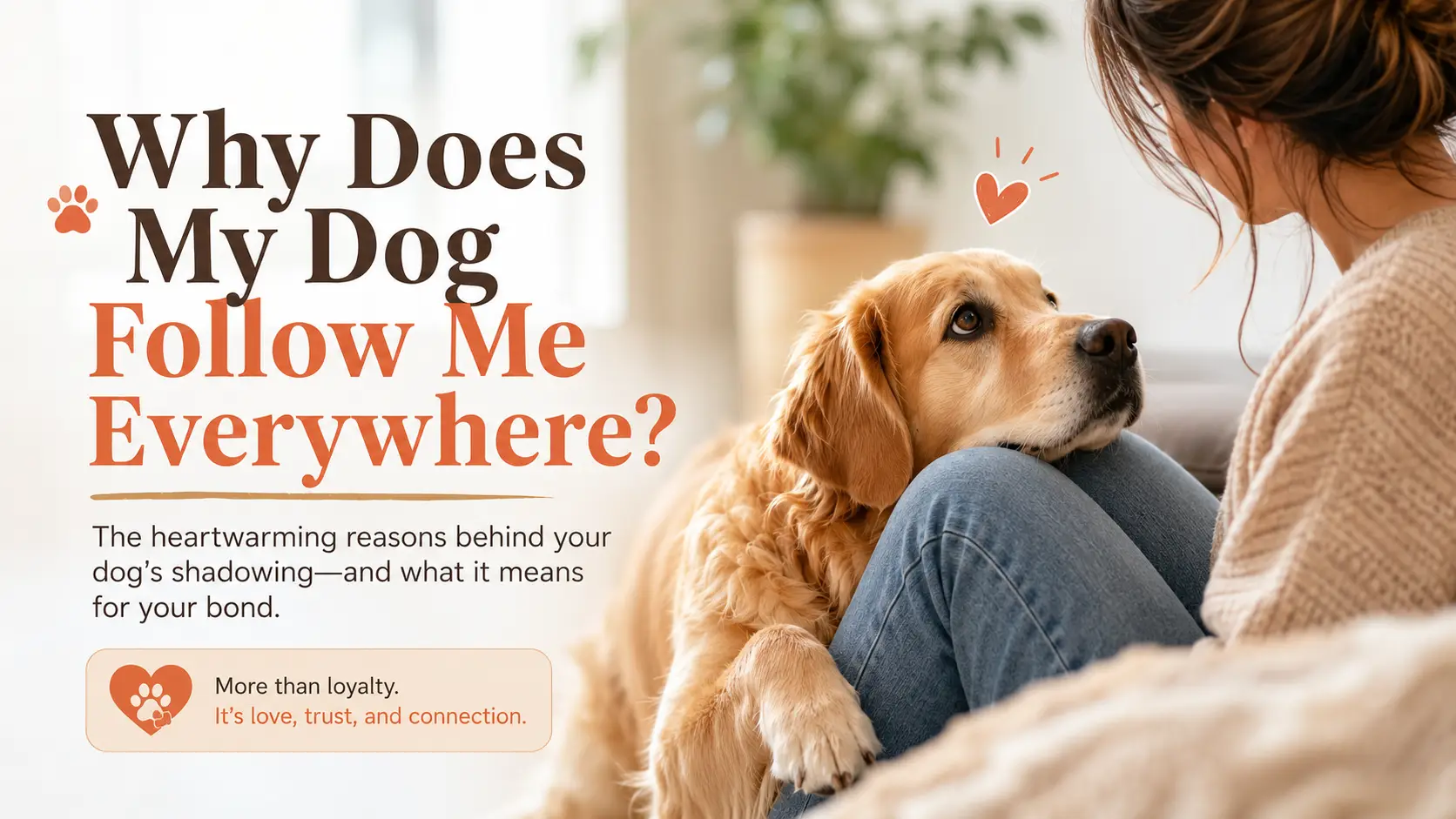
It happens so quietly that you almost stop noticing it.
You get up to make tea, and there they are behind you. You move to the other side of the room, and paws follow. You close the bathroom door and hear a small, patient thump as a body settles down against it — waiting. Not whining. Just waiting, because you are in there and they are out here, and to them that is a distance worth guarding.
If you have found yourself smiling and quietly wondering, "Why does my dog follow me everywhere?" — the answer is one of the most beautiful things science has learned about dogs. But it also comes with one gentle caution, and that caution is the reason this guide exists.
The short answer: Most dogs follow their people because of genuine attachment — you are their safe place, their source of everything good, and the centre of their social world. Breed instincts, learned habit, and simple companionship all add to it. This is normal and healthy. It becomes worth attention only when your dog cannot cope with being apart from you at all: pacing, panting, destruction, house-soiling or howling that begins within minutes of you leaving. That is separation anxiety, and it is a different thing — treatable, but it needs a plan.
You Are Not Just Their Owner. You Are Their Safe Base.
In the 1990s, researchers began testing dogs using an adapted version of the "Strange Situation" — the same experiment psychologists use to measure attachment between human infants and their parents. The results were striking. Dogs behaved much like young children do: they explored more confidently when their person was present, showed distress when that person left, and greeted them with clear relief when they returned.
A 2013 study published in PLOS ONE took it further. Dogs were given a food puzzle to solve. They worked at it noticeably harder and longer when their own owner was in the room — even a silent, unhelpful owner sitting quietly — than when a friendly stranger was there instead. The researchers called it the secure base effect, and it was owner-specific.
Read that again, because it is worth sitting with: your dog is braver when you are nearby.
That following-you-around is not neediness. It is your dog carrying their courage with them. You are the fixed point they navigate the world from — the one thing in the house that means nothing bad is happening right now.
The Chemistry of Being Followed
There is a hormone in this story, and it is the same one behind human bonding.
In a landmark 2015 study published in Science, Nagasawa and colleagues found that when dogs gazed at their owners, the owners' oxytocin levels rose — and that rise led the owners to touch and talk to their dogs more, which then raised oxytocin in the dogs too. A loop. A quiet, self-feeding loop of affection, running on eye contact.
The most telling detail: hand-raised wolves, tested the same way, did not do this. This gaze-and-bond loop appears to be something dogs developed with us, over thousands of years of living alongside human beings.
So when your dog trails you to the kitchen and then just looks up at you — that look is not empty. Something is genuinely happening in both of you.
Why Your Dog Follows You: The Everyday Reasons
Attachment is the foundation. But most following behaviour is a mix of several ordinary, very doggy things stacked on top of it.
1. You are the source of everything good
Food comes from you. Walks come from you. The leash, the door, the ball, the ear scratch, dinner, the good sofa spot — all of it flows through you. Dogs are superb pattern-learners, and they have concluded, entirely reasonably, that standing near you is the highest-probability place for good things to occur.
Every time you toss a piece of chicken while cooking, or fuss over them the moment they appear beside you, that pattern is quietly reinforced. This is the most common reason of all, and it is also the most affectionate one: following you works.
2. They are social animals who were never built to be alone
Dogs descend from a highly social species and were then shaped by domestication to live inside human families. Being with their group is not a preference — it is close to a biological default. Solitude is the unnatural state.
To a dog, the household is the pack, and packs move together. When you get up and walk away, some part of them registers the group is splitting up, and the simplest fix is to come along.
3. Their breed was designed for it
Some dogs are far more likely to become what trainers affectionately call "velcro dogs." Breeds developed to work in close partnership with a single handler are especially prone to it:
- Herding breeds — Border Collies, German Shepherds, Australian Shepherds — bred to read one handler's every movement
- Companion and lap breeds — Cavalier King Charles Spaniels, Shih Tzus, Pugs, Frenchies — bred, quite literally, for closeness
- Sporting breeds — Labradors, Golden Retrievers, Cocker Spaniels — bred to stay near a hunter for hours
- Toy and small terriers — often raised carried and cuddled from puppyhood
If your dog's ancestors spent centuries within a few feet of a human, do not be surprised that yours does too.
4. Puppyhood and personality
Puppies follow instinctively — it is a survival reflex, and it is how they learned to stay safe with their mother. Many carry it into adulthood. Rescue dogs who have known loss or upheaval often shadow their new person intensely in the first months, as they slowly work out that this home is not going to disappear.
And some dogs are simply like this. Same breed, same house, same upbringing — one dog sprawls happily alone in another room, the other cannot rest until everyone is in the same room. Personality is real.
5. Boredom, in disguise
An under-stimulated dog follows you because you are the most interesting thing in the house. If a dog has already slept, already eaten, and has nothing to do, you become the entertainment. Following turns into a job.
This is one of the easiest reasons to test. Add a real walk, a sniffing session, a training game or a food puzzle to the day, and see if the shadowing softens.
When It Is Something Worth Attending To
Here is the part every dog parent should read carefully — and where most of the internet gets it wrong.
Being clingy and having separation anxiety are not the same thing. A velcro dog prefers to be with you. A dog with separation anxiety panics without you. The difference isn't how closely they follow you when you're home — it is what happens the moment you leave.
According to the ASPCA, signs of separation anxiety appear soon after departure — often within minutes — and include:
- Barking, howling or whining that starts almost as soon as you're gone and continues
- Chewing, digging or destruction concentrated at doors, windows and exit points
- Urinating or defecating indoors in a dog who is otherwise reliably house-trained
- Pacing, often in a fixed pattern or line
- Heavy drooling, panting or trembling
- Distress that begins before you leave — as you pick up your keys, put on your shoes
- Escape attempts intense enough to injure themselves — broken nails, damaged teeth, scraped paws
- Frantic, prolonged greetings on your return, as if you had been gone for weeks
An important clue: dogs with true separation anxiety usually will not eat when alone. A dog who happily works through a stuffed food toy the second you shut the door is very likely fine.
If you recognise several of these signs, this is not a discipline problem and your dog is not being spiteful. They are frightened. Punishment makes it worse — a scolded, anxious dog simply becomes more anxious. What works is a structured desensitisation and counter-conditioning plan, ideally guided by your veterinarian or a qualified behaviour professional, and in some cases supported by medication.
Please note: Filming your dog with a phone or camera for 30 minutes after you leave is the single most useful thing you can do. Owners are routinely surprised — in both directions. Bring that video to your vet.
The change that deserves a phone call
There is one pattern that should always be taken seriously: following behaviour that is new, sudden, and unlike your dog.
A dog who has always been independent and now cannot leave your side may not be feeling more affectionate. They may be feeling unwell, frightened, or confused. Clinginess can accompany pain, nausea, failing eyesight or hearing, and — in older dogs — canine cognitive dysfunction, the canine parallel of dementia, where a familiar house stops making sense and you become the only landmark left.
Cornell University's Riney Canine Health Center notes that anxious behaviours in dogs frequently have medical contributors, and a veterinary exam should come before behavioural conclusions.
So, the simple rule: lifelong shadow = personality. New shadow = check-up.
How to Live Happily With a Velcro Dog
If your dog is following you out of love rather than fear, you do not need to fix anything. Many people genuinely enjoy it — it is, after all, one of the loveliest things about sharing a home with a dog.
But a dog who can also be alone comfortably is a dog who suffers less on the days life makes you leave. Building that is a kindness, not a rejection.
Teach the pleasure of settling. Give your dog a bed or mat of their own and reward them, calmly and often, for choosing it — even when you are a few feet away. You are teaching them that relaxing away from you is its own good thing.
Practise tiny separations, every day. Step into another room and shut the door for five seconds. Come back with no fuss. Then ten seconds. Then a minute. Keep every absence shorter than the point where your dog starts to worry. This is unglamorous and it works.
Make leaving boring. No emotional goodbyes, no dramatic reunions. If your comings and goings are low-key, they stop being events worth dreading.
Give departures a job. A frozen stuffed food toy, offered only when you leave, changes the emotional meaning of the door closing. Take it away when you return so it stays special.
Fill the day properly. A dog who has walked, sniffed, chewed, trained and thought is a dog who can nap while you work. Sniffing in particular is deeply settling for dogs — a slow twenty-minute walk where they get to read the world beats a brisk lap around the block.
Don't reward the shadow every single time. You do not need to be cold. Just avoid making every appearance at your feet produce a treat or a fuss. Reward them sometimes when they are settled elsewhere instead — that is the behaviour you want to grow.
Never punish the following. It is affection or anxiety, and neither one responds to anger. Punishment only teaches a dog that being near you is unpredictable, which is the opposite of what you want.
Frequently Asked Questions
The Part Worth Remembering
One day the following stops.
The paws no longer appear behind you in the kitchen. The patient thump against the bathroom door does not come. And every dog parent who has reached that day will tell you the same thing: they would give almost anything to be followed around one more time.
So while it is happening — while there is a small, devoted creature who thinks the most interesting place in the entire world is wherever you happen to be standing — try to notice it. Not as a behaviour to solve. As the compliment it is.
Your dog has decided that you are home. Everything else is just the room they are in.
Sources and Verification
Everything in this guide is drawn from peer-reviewed research and veterinary institutions. We do not diagnose, and this article is not a substitute for veterinary advice.
- Horn L, Huber L, Range F (2013). The Importance of the Secure Base Effect for Domestic Dogs — Evidence from a Manipulative Problem-Solving Task. PLOS ONE. — journals.plos.org
- Nagasawa M, Mitsui S, En S, et al. (2015). Oxytocin-gaze positive loop and the coevolution of human-dog bonds. Science, 348(6232), 333–336. — science.org
- ASPCA. Separation Anxiety — Common Dog Behavior Issues. — aspca.org
- Cornell University College of Veterinary Medicine, Riney Canine Health Center. Anxious behavior: How to help your dog cope with unsettling situations. — vet.cornell.edu
- PetMD (veterinarian-reviewed). Clingy Dog Behavior — What to Know About Velcro Dogs. — petmd.com
A note on veterinary care: If your dog's clinginess is new, worsening, or paired with any change in appetite, toileting, sleep or mood, please speak to your veterinarian. Sudden behavioural change is one of the most common ways dogs tell us something physical is wrong.
Found this helpful? Share it with a fellow dog parent:
References & trusted sources
- Horn, Huber & Range 2013 — The Importance of the Secure Base Effect for Domestic Dogs (PLOS ONE)
- Nagasawa et al. 2015 — Oxytocin-gaze positive loop and the coevolution of human-dog bonds (Science)
- ASPCA — Separation Anxiety in Dogs
- Cornell Riney Canine Health Center — Anxious behavior: helping your dog cope
- PetMD (vet-reviewed) — Clingy Dog Behavior / Velcro Dogs
Keep your dog's care organized
The Complete Dog Care Planner turns all of this into one calm, simple routine you can actually stick to.