
How to Train a Puppy: The Complete Beginner’s Guide (Backed by Science)
A practical, reward-based puppy training guide covering safe socialization, house training, crate comfort, biting, basic cues, leash skills and alone time.
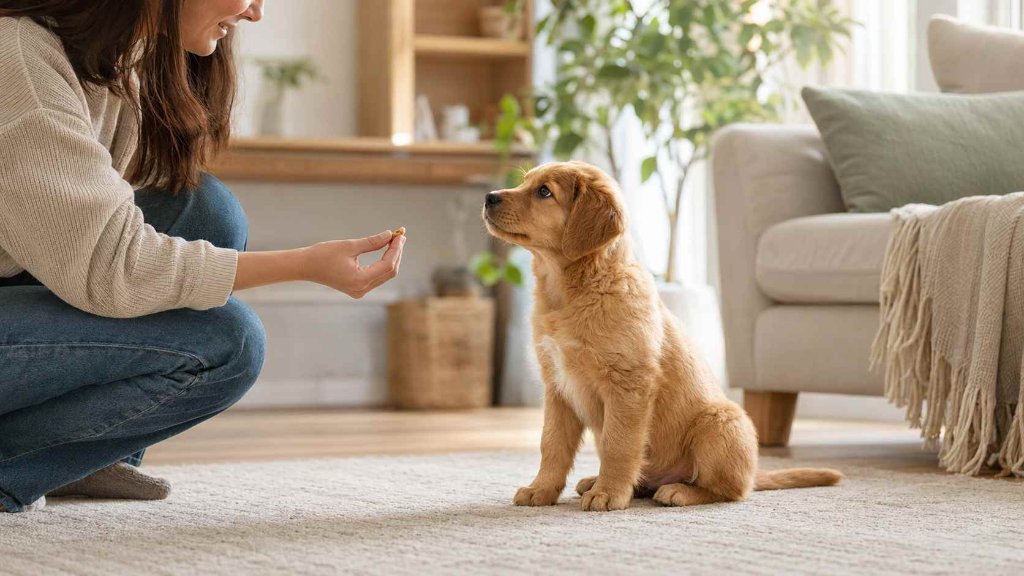
Bringing home a new puppy is one of life’s happiest experiences. There are tiny paws, curious eyes, sleepy cuddles—and, usually, a chewed shoe, a puddle on the rug and a burst of barking when everyone else is trying to sleep.
The good news is that learning how to train a puppy does not require harsh corrections or perfect timing. It requires a simple plan, suitable rewards, realistic expectations and plenty of calm repetition.
This beginner-friendly puppy training guide explains when to start, how long to practise, which skills to teach first, and how to handle socialization, potty training, crate training, biting, leash walking and alone time using reward-based methods.
Quick answer: Begin gentle training as soon as your puppy comes home, often around 7–8 weeks of age. Practise for a few minutes at a time, reward the behaviour you want, prevent unsafe choices and gradually add difficulty only while your puppy is succeeding.
Safety note: This guide provides general education and cannot assess your puppy’s health, vaccination status or behaviour. Ask your veterinarian about local disease risks and seek professional help for sudden behaviour changes, panic, aggression or bites that break skin.
When should you start training a puppy?
You can begin gentle training as soon as your puppy arrives home. For many families, that is at about 7–8 weeks old.
Training at this age does not mean expecting long stays or perfect leash manners. It means teaching small, useful lessons:
- Looking toward you when you say their name
- Following you for a treat
- Going to the toilet in the right place
- Feeling safe when handled
- Settling on a bed or in a pen
- Learning that calm behaviour brings good things
Early social learning is especially important. The American Veterinary Society of Animal Behavior (AVSAB) identifies the first three months as the most important period for puppy socialization. Experiences during this stage can influence how a dog responds to people, animals, environments and everyday events later in life.
If your puppy is older, do not worry—you have not “missed your chance.” Dogs can continue learning throughout life. An older puppy may simply need a slower, more individual plan, particularly if they already show fear or avoidance.
Why reward-based puppy training works best
Reward-based training means reinforcing behaviours you want to see again. The reward might be a tiny piece of food, a toy, praise, access to sniffing or another activity your puppy values.
AVSAB’s position statement on humane dog training recommends reward-based methods for canine training and advises against techniques that rely on pain, fear, intimidation or physical force.
A 2020 PLOS ONE study found that dogs attending schools using more aversive methods displayed more stress-related behaviour during training, greater increases in cortisol and a more pessimistic response in a cognitive-bias task than dogs attending reward-based schools. In a 2009 owner survey, aggressive responses were frequently reported following some confrontational methods, including alpha rolls and physical manipulation. Because that study was a survey, it shows an association reported by owners rather than proving that every such method caused aggression.
The practical rule is simple:
Reward the behaviour you want, prevent or calmly interrupt unsafe behaviour, and teach your puppy an appropriate alternative.
Reward-based does not mean allowing a puppy to do anything they like. Puppies still need clear routines, safe boundaries and consistent guidance—without fear, pain or intimidation.
How long should puppy training sessions be?
Keep formal sessions short: often three to five minutes is enough for a young puppy. You can repeat these mini-sessions several times during the day.
End while your puppy is still engaged. If they wander away, scratch, sniff the floor repeatedly or stop taking treats, the lesson may be too long, too difficult or taking place in an environment with too many distractions.
Everyday routines also create natural training opportunities:
- Ask for a sit before placing the food bowl down.
- Reward your puppy for checking in with you during a walk.
- Practise recall between two family members indoors.
- Reinforce four paws on the floor when greeting.
- Offer a chew when your puppy settles on their bed.
Frequent, easy successes usually teach more than one long, tiring session.
Step 1: Socialize your puppy safely
Socialization is much more than meeting other dogs. Its purpose is to help a puppy form safe, positive associations with the people, animals, sights, sounds, surfaces, handling and environments that may be part of everyday life.
Useful experiences can include:
- Adults and children who interact calmly and follow instructions
- People wearing hats, uniforms or glasses and people using mobility aids
- Healthy, friendly, appropriately vaccinated dogs
- Car journeys and gentle veterinary handling practice
- Household sounds such as the vacuum, doorbell and kitchen appliances
- Surfaces such as carpet, tile, grass, concrete and safe metal grates
- Low-volume recordings of thunder or fireworks, increased only while the puppy remains relaxed
- Calm visits to suitable homes and carefully managed puppy classes
Balance socialization with vaccination safety
Ask your veterinarian about disease risks in your area before placing an incompletely vaccinated puppy on public ground.
AVSAB states that healthy puppies can generally begin well-managed socialization classes at 7–8 weeks after receiving at least one vaccine set a minimum of seven days before the first class and an initial deworming. Vaccinations should remain current throughout the course.
Until your veterinarian advises otherwise:
- Avoid dog parks and areas heavily used by dogs of unknown health or vaccination status.
- Avoid contact with sick or unvaccinated animals.
- Choose classes with appropriate health requirements and surfaces that can be cleaned and disinfected.
- Carry your puppy or use a clean blanket, stroller or secure carrier when you want them to observe a public setting without touching potentially contaminated ground.
Watch your puppy’s body language. If they freeze, hide, tuck their tail, refuse food, try to escape or become unusually still, increase the distance or end the experience. Socialization should not involve forcing a frightened puppy to “get used to it.”
Thoughtful socialization can reduce the risk of later fear and reactivity, but it cannot guarantee a particular adult temperament. Genetics, health and later experiences also matter.
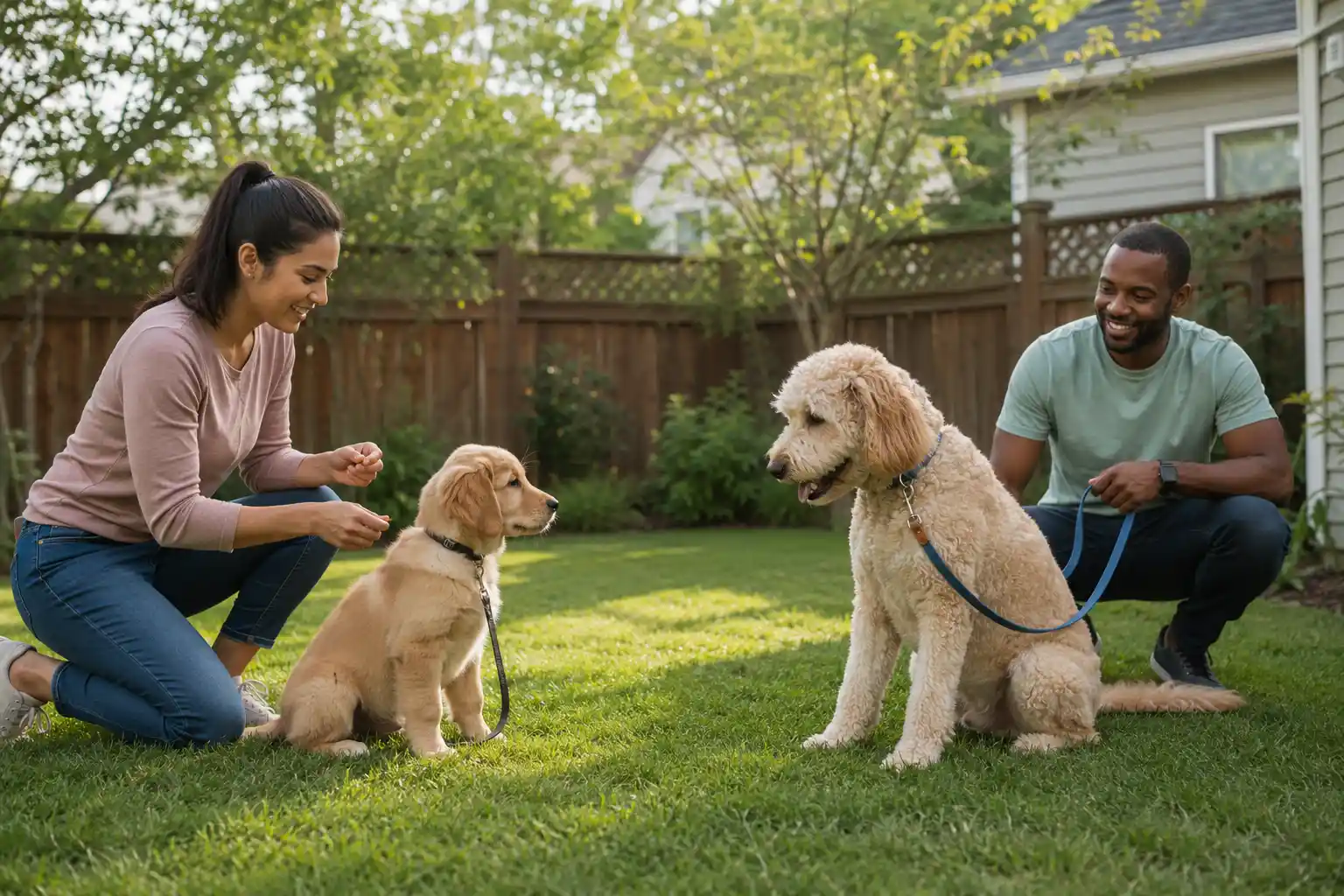
Safe, positive experiences help puppies build confidence without forcing interaction.
Step 2: Teach five useful puppy cues
Start in a quiet room with small, soft treats. Say each cue once, then help your puppy succeed. Practise one skill at a time.
1. Name response
Say your puppy’s name once in a warm voice. The moment they turn toward you, mark the behaviour with “yes” or a clicker and give a reward. Their name should predict attention and connection, not scolding.
2. Sit
Hold a treat close to your puppy’s nose, then move it slowly upward and slightly back. As their nose follows, their bottom will often lower. Mark and reward the moment they sit. Add the word “sit” when the movement is becoming predictable.
Do not push their hips down. If luring does not work comfortably, try on a non-slip surface or capture the behaviour by rewarding a sit your puppy offers naturally.
3. Come
Begin indoors at a very short distance. Say your puppy’s name followed by “come” in a cheerful voice, then move backward slightly. Reward generously when they reach you.
Never punish your puppy after they come, even if they took their time. Outdoors, practise with a long line attached to a well-fitted harness or in a securely enclosed area. Do not test an unproven recall near traffic, open gates or other hazards.
4. Leave it
Place a low-value treat in a closed hand. Wait quietly. The moment your puppy moves their nose away or looks at you, mark and reward them with a different treat from your other hand.
Once they understand the game, add the words “leave it” before presenting your closed hand. Progress gradually to an item on the floor protected by your foot, then to real-life situations at a safe distance.
“Leave it” means do not take the item. Teach a separate “drop” or “give” cue for something already in the puppy’s mouth. If your puppy has swallowed a potentially toxic or dangerous object, contact a veterinarian promptly rather than relying on training.
5. Down
From a sit or standing position, move a treat from your puppy’s nose toward the floor and then slightly forward. Mark and reward when their elbows and body reach the floor.
Some puppies find this position uncomfortable or vulnerable. Use a non-slip surface, avoid physical pressure and take a break if they appear worried or reluctant.
Step 3: Potty train with a predictable routine
House training takes time because young puppies have limited bladder and bowel control. Progress varies with age, health, routine, previous learning and the consistency of supervision.
Use this simple system:
- Offer frequent toilet opportunities. Take your puppy to the designated area after waking, eating, drinking, active play and before sleep. Very young puppies may need additional trips.
- Use the same location when practical. Familiar scent and context can help your puppy understand the purpose of the trip.
- Wait quietly. Keep the trip boring until your puppy toilets.
- Reward immediately. Mark and reward within a second or two of completion, while you are still outside.
- Supervise or safely confine. When you cannot watch closely, use an appropriately introduced crate, puppy pen or puppy-safe room for a suitable period.
- Learn the early signs. Sniffing, circling, restlessness or suddenly leaving the room can mean your puppy needs to go.
Do not punish accidents or rub your puppy’s nose in them. If you catch an accident beginning, calmly interrupt and take the puppy to the toilet area. If you discover it later, clean it without reacting.
Use an enzymatic pet cleaner according to its directions. Standard household cleaning may leave odour that encourages a puppy to return to the same area.
If a previously reliable puppy suddenly begins having accidents, strains, urinates frequently, seems painful or drinks much more than usual, speak with a veterinarian. A medical problem can look like a training setback.
Step 4: Make crate training safe and positive
A crate can support rest, travel, recovery and house training when it is introduced gradually and used for appropriate periods. It is not essential for every household; a puppy pen or properly puppy-proofed room can be a suitable alternative.
Choose a crate that is well ventilated and large enough for your puppy to stand, turn around and lie down comfortably.
A gradual crate-training plan
- Secure the door open and let your puppy investigate voluntarily.
- Toss treats near the entrance, then just inside.
- Feed meals at a comfortable distance and gradually move the bowl inside.
- When your puppy enters happily, move the door a little and reward. Build toward closing it briefly.
- Increase time by seconds, not large jumps, while you remain nearby.
- Add distance separately, returning before your puppy becomes distressed.
- Mix easy repetitions with slightly longer ones rather than making every attempt harder.
Important crate-safety rules:
- Remove your puppy’s collar and harness inside the crate because they can catch on the bars.
- Use bedding, chews and toys only if they are safe for your individual puppy and will not be shredded or swallowed.
- Provide frequent toilet, movement, play and social breaks appropriate to the puppy’s age and needs.
- Never use the crate for punishment or prolonged isolation.
- Do not leave a puppy crated longer than they can comfortably hold their bladder.
Mild, brief uncertainty can mean the exercise progressed too quickly; make the next repetition easier. If your puppy is panicking, trying frantically to escape, drooling heavily, injuring themselves or unable to settle, stop and seek guidance from a veterinarian or qualified reward-based behaviour professional. The AKC’s current crate-training guidance likewise advises stopping and seeking help when a dog appears panicked.
Step 5: Handle puppy biting and mouthing calmly
Mouthing is a normal part of puppy play and exploration, but puppies still need to learn that teeth on human skin or clothing end the interaction.
Try this approach:
- Keep appropriate toys and chews within reach.
- If teeth touch skin or clothing, calmly stop moving and end the interaction.
- Step away briefly if your puppy persists.
- Resume only when they are calmer, then redirect them to a suitable toy.
- Notice patterns. Puppies often become mouthier when overtired, overexcited, hungry or in need of a toilet break.
- Give children and puppies close adult supervision; excited movement can intensify chasing and nipping.
- Make sure everyone responds consistently.
Avoid hitting, holding the muzzle closed or using physical punishment. A high-pitched yelp excites some puppies, so it is not a universal solution. Calmly ending play is clearer and is consistent with the central advice in VCA’s puppy play-biting guidance.
Mouthing often decreases as teething ends and training progresses, but every puppy develops differently. Contact a veterinarian or qualified reward-based behaviour professional if the puppy repeatedly bites hard, breaks skin, freezes or stiffens before biting, guards food or objects, growls in a concerning context, or if anyone in the household feels unsafe.
Step 6: Begin loose-leash training
Start indoors or in a quiet, securely enclosed area. Let your puppy become comfortable wearing a properly fitted harness or collar for short, supervised periods.
Reward your puppy for standing near you and for taking one or two steps while the leash is loose. If the leash tightens, stop or change direction gently rather than jerking it. When your puppy returns toward you or the leash becomes loose, reward and continue.
Keep early walks short and allow time for safe sniffing. Sniffing is valuable enrichment and can also be used as a reward: a few loose-leash steps can earn permission to investigate an interesting scent.
Choose equipment based on your puppy’s size, health and handling needs. Ask your veterinarian or a qualified trainer for help if your puppy coughs, gags, lunges strongly or appears uncomfortable.
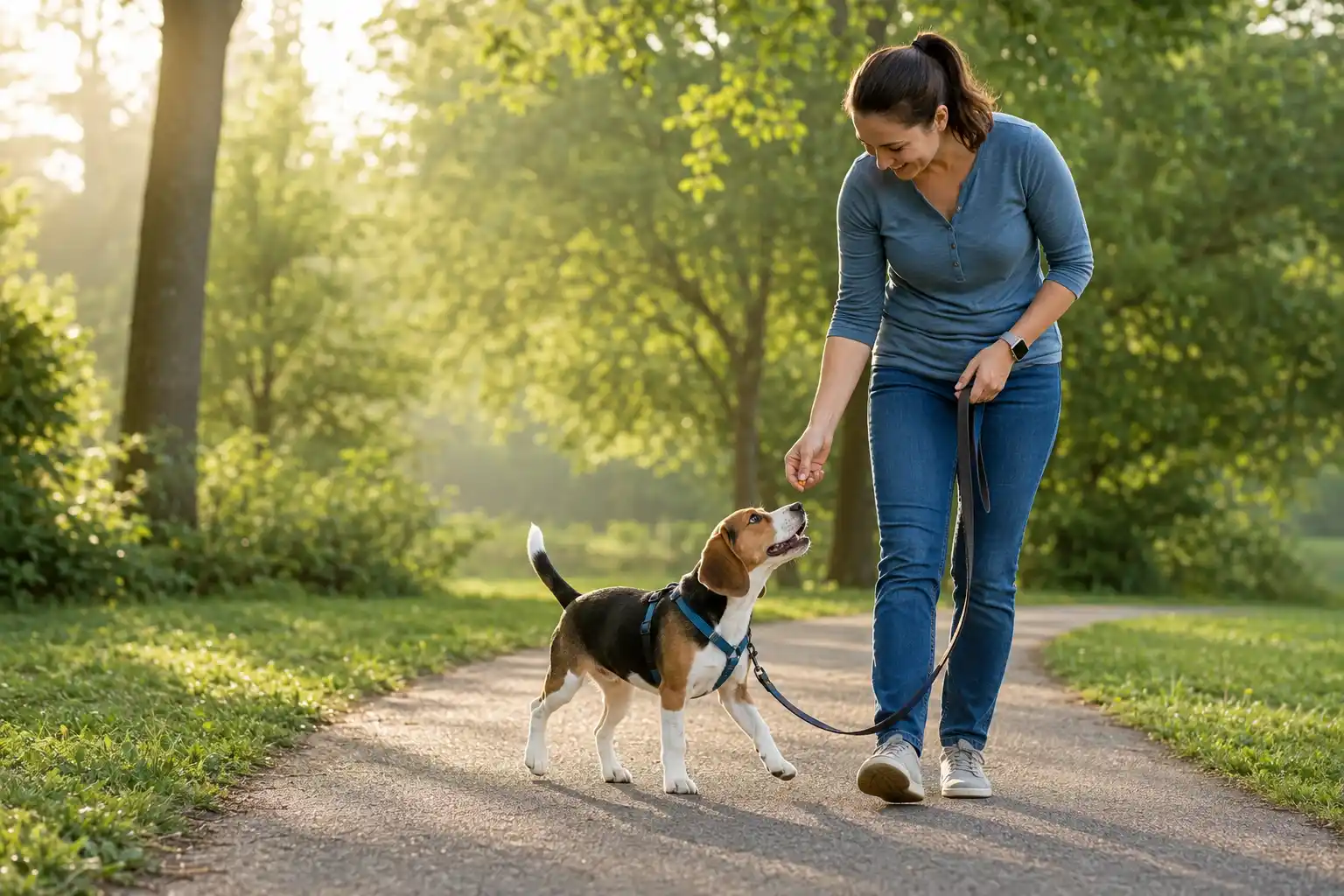
Rewarding attention and a loose leash makes early walks clearer and more enjoyable.
Step 7: Teach your puppy to be comfortable alone
Alone-time training is different from simply leaving a puppy until they stop crying. The goal is to build a history of short, safe separations that end before distress escalates.
Begin after your puppy has toileted and had suitable activity:
- Settle your puppy in a safe pen, room or comfortably introduced crate with an appropriate food toy or chew.
- Stay nearby while they relax.
- Step out of sight for one or two seconds, then return calmly.
- Repeat at an easy level and increase the duration gradually.
- Practise ordinary departure cues—picking up keys, putting on shoes—without always leaving.
Use a camera if possible so you can see whether your puppy remains relaxed. Do not make large jumps from seconds to hours.
If your puppy cannot eat, vocalizes continuously, pants or drools when it is not hot, destroys exit points, soils despite being house-trained or attempts to escape, contact your veterinarian. Pain, illness and separation-related distress require more than a basic training plan.
Common puppy training mistakes—and what to do instead
| Mistake | Why it causes difficulty | Better approach |
|---|---|---|
| Waiting for the puppy to “grow out of” everything | Useful early learning opportunities are lost | Begin gentle training and safe socialization as soon as the puppy comes home |
| Using punishment or “dominance” techniques | These methods can increase stress, fear and defensive responses | Use rewards, prevention, redirection and humane management |
| Letting family members use different rules or cues | Inconsistent outcomes make learning harder | Agree on household words, boundaries and reward strategies |
| Training for too long | A tired or distracted puppy stops learning effectively | Use several short, successful sessions |
| Forcing social contact | Overwhelming exposure can increase fear | Give the puppy distance, choice and positive associations |
| Repeating a cue many times | The repeated word can become background noise | Say it once, help the puppy succeed, then make the next repetition easier |
| Increasing duration, distance and distraction together | The difficulty rises too quickly | Change only one variable at a time |
| Expecting progress to be perfectly linear | Teething, adolescence, stress and health can affect performance | Review the basics, lower the difficulty and rule out medical problems |
A realistic puppy training timeline
Age is only a guide. Vaccination status, health, breed traits, confidence and previous experience should shape your individual plan.
| Approximate stage | Useful priorities |
|---|---|
| 7–8 weeks onward | Name response, toilet routine, gentle handling, settling, safe socialization, very short separations |
| 8–14 weeks | Carefully managed positive experiences; introductory cues; crate or pen comfort; bite-management routines |
| 3–4 months | Continue socialization; build recall, leave it, down and loose-leash foundations |
| 4–6 months | Practise around gradual distractions; reinforce calm greetings; support the puppy through teething |
| 6–12 months | Revisit foundations during adolescence; use a long line for recall; continue rewards in real-life settings |
| Adulthood | Maintain important skills and continue positive exposure, enrichment and learning |
When should you seek professional help?
Contact your veterinarian first when behaviour changes suddenly or could have a medical cause. Ask for help promptly if you see:
- Panic during confinement or separation
- Severe or worsening fear
- Guarding of food, toys, spaces or people
- Bites that break skin or repeated hard biting
- Growling, freezing, snapping or lunging that makes anyone feel unsafe
- Self-injury or frantic escape attempts
- A sudden loss of house-training reliability
- Behaviour that is becoming harder despite consistent reward-based training
For training or behaviour support, look for a professional who clearly explains their methods, uses rewards and humane management, and does not rely on shock, prong or choke collars, alpha rolls, intimidation or pain. Serious aggression, fear or anxiety may require a veterinarian working with a qualified behaviour professional.
Consistency matters more than perfection
Puppies learn through repetition and consequences, not through human ideas of being “good” or “bad.” Calm, predictable responses help them understand what works.
Consistency does not mean expecting perfection every day. Puppies become tired, distracted, overstimulated and adolescent. When a skill seems to disappear, lower the difficulty, reduce distractions and reward the simple version again.
Every successful recall, quiet settle and toilet trip is a small investment in the adult dog your puppy will become. Keep sessions short, protect your relationship and make learning enjoyable for both of you.
Continue your puppy-care journey with our dog care guides, get personalised next steps from the AI Training Advisor, or organise daily routines with The Complete Dog Care Planner.
Frequently Asked Questions
Found this helpful? Share it with a fellow dog parent:
References & trusted sources
- American Veterinary Society of Animal Behavior. Position Statement on Humane Dog Training.
- American Veterinary Society of Animal Behavior. Position Statement on Puppy Socialization.
- American Veterinary Medical Association. Literature Review on the Welfare Implications of Socialization of Puppies and Kittens.
- Vieira de Castro AC, Fuchs D, Morello GM, et al. Does training method matter?
- Herron ME, Shofer FS, Reisner IR. Survey of confrontational and non-confrontational training methods.
- American Kennel Club. Safe and Stress-Free Crate Training.
- VCA Animal Hospitals. Play Biting in Puppies.
Keep your dog's care organized
The Complete Dog Care Planner turns all of this into one calm, simple routine you can actually stick to.